
News
Top stories that dominated Kano in 2018

January – March
Kwankwaso’s visit to Kano aka “Zuwan Mahadi Kano”

Kwankwaso and Ganduje
The early months of 2018 were dominated by the factional crises within the ruling APC in Kano between the Kwankwasiyya and Gandujiyya factions. The opening salvo was the proposed visit by Kwankwasiyya leader Rabiu Musa Kwankwaso ostensibly to inaugurate the factions’ candidates for the local government elections scheduled to take place in February.
On 2nd January, Kano state governor was reported to be welcoming the senator while warning that he will not tolerate security breach. On 10th January commissioner for special duties Abdullahi Abbas instructed loyalists to stone the “political Satan” of Kano in a direct allusion to Kwankwaso.
The following week, six Kwankwasiyya loyalists including Walidi Abbas younger brother to Abdullahi Abbas were injured at a wedding on January 14. The next day police arrested the commissioner, his two children Sani and Abbas for alleged complicity in the attacks.


Walid Abbas: Injured in Kwankwasiyya Gandujiyya clash.
On January 26, the commissioner of Police Rabiu Yusuf advised Kwankwaso to shelve the visit. According to the commissioner, the move was to avert expected clashes with Gandujiyya loyalists.
In a similar vein, Gandujiyya faction announced plans to hold successive rallies in Bichi, Gwarzo, Kwanar Dangora and Wudil from starting from January 28th. The Kwanar Dangora event was conveniently scheduled for the 30th of the month when Kwankwasiyya adherents were expected to troop into Kano from Kaduna.
Rabiu Kwankwaso insisted that he would be visiting Kano on the set date and alleged that the commissioner of police had been comprised by Abdullahi Ganduje. However, a day to the event, Kwankwaso shelved the visit citing the intervention of elders.
The matter was on 1st February, tabled before the senate by Isah Hamma Misau (APC, Bauchi Central) but the two other senators from Kano, Kabiru Gaya (APC, Kano South) and Barau Jibrin (APC, Kano North) asked for the issue to be treated as a family matter. Kwankwaso refused to comment.
Underage voting in Kano election

Montage of children voting in Kano LG elections.
On Saturday 10th February Kano state Independent Electoral Commission KANSIEC conducted local government chairmanship and councillorship elections with the ruling All Progressives Congress APC winning all 44 local government chairman and 484 councillors seats.
While declaring the results at a press conference at KANSIEC Headquarters, the Chairman of the commission, Garba Ibrahim Sheka, said 25 political parties, including the People’s Democratic Party (PDP), participated in the election with ruling All Progressives Congress winning all the seats.
However, video footage from the election showed some children casting ballots contrary to provisions of the electoral laws.
Sequel to calls from election observers, civil society groups, human rights groups and activists on the alleged underage voting, the Independent National Electoral Commission INEC set up a committee to investigate the allegations.
The INEC report debunked the allegations saying that there was no any incident of underage voting and the pictorial depictions of childhood voters represented a clear manipulation of images to create a fake story.
The report asserts that some of the images presented as children voting were actually children on the queue for food at an Internally Displaced Persons camp in Borno State.
Fatima Ganduje’s Wedding

Fatima Ganduje showing her dance moves.
On Saturday March 2, 2018 Kano state received prominent personalities, including President Muhammadu Buhari, as they attended the wedding Fatiha of governor Abdullahi Ganduje’s daughter, Fatima and her groom, Idris Ajimobi son of Oyo state governor.
The wedding created an uproar due to the flamboyant display of wealth by the couple’s parents and open show of affection by the couple themselves. Mr. Buhari was flayed by critics for attending the event even as bloodletting continued unabated in many states across the nation as a result of herdsmen/farmers clashes.
A week before the wedding the Ajimobi clan including the first lady, their daughters and a few northern first ladies visited Kano State Government House to present the bride’s trousseau.
The bride-to-be received 27 customized Louis Vuitton travel boxes from her in-laws. While the contents of the LV boxes cannot be ascertained, each designer travel bag is estimated to cost about $5,000.00.
Another part of the story that attracted public censure were the skimpy dresses and crazy dance steps of the bride as well as videos and pictures of the couple cuddling and kissing in public.
An Islamic scholar Ahmad Gumi criticized the wedding by warning the people of Kano to be cautious of the “wrath of God” lest He inflicts them with the same type of crisis plaguing Borno State.
April – June
KUST students’ protest
The second quarter of 2018 was dominated by a students, protest in one of the Kano state owned universities.
In May 2018 the Senate of Kano State University of Science and Technology (KUST), Wudil, ordered students of the university to proceed on a two-week mid–term break following a violent demonstration.
KANO TODAY recalls that, on Wednesday May 2, 2018 hundreds of students launched an overnight protest to convey their displeasure over the circumstances surrounding the death of their colleague, one Faruk Abubakar, who died while swimming at River Wudil.

KUST students protest.
Three students of the University had gone to the river to swim and had ran into problems in the exercise, which resulted in the death of one of them as well as exposed the rest to a life- threatening situation.
During the protest, the students set up bonfire, barricaded the roads and damaged some property belonging to the university.
A month after the protest the Senate on June 22, 2018 ordered the students to pay N17,000 before resuming their studies.
According to the senate, N13,000 was the penalty for damages caused while N4,000 was to be used to test each student’s mental health before resuming to school.
An uproar followed the decision with most stakeholders crying that the universal application of the fine on all students was unfair and the sum was too expensive.
After the intervention of Kano state governor Abdullahi Umar Ganduje the penalty fees was reduces to 13, 000 instead of 17,000.
July – September
Political cross carpeting – Kwankwaso/Shekarau
The third quarter of 2018 saw a switch of political allegiances involving the two main political gladiators in Kano state, former governors Rabiu Kwankwaso and Ibrahim Shekarau.
On July 24 Kwankwaso decamped to PDP after failing to get the support of APC national leadership in his feud with incumbent governor Abdullahi Ganduje. He was welcomed by Shekarau initially as they met in the latters’ house in Asokoro, Abuja on 28th July.
Aside being a serving senator, Kwankwaso has in his political kitty, nine members of the House of Representatives (who defected with him), Kano deputy governor, Hafiz Abubakar, about ten members of the Kano House of Assembly and thousands of Kwankwasiya members spread across Nigeria.
This made the PDP to dissolve the Kano state exco of the party and appoint a caretaker committee headed by Kwankwasiyya leader Rabiu Suleiman Bichi.

Sheakarau welcoming Kwankwaso to PDP.
PDP leaders Shekarau and Aminu Wali resisted the move while the presidency and APC wooed Shekarau leading to his decamping to the APC. On September 7th Shekarau joined APC where he was welcomed by the party chairman Adams Oshiomhole and given Kwankwaso’s senatorial seat. He however lost some of his supporters who elected to stay with Kwankwaso.
During the PDP primary elections Kwankwaso contested and lost the presidential ticket of the party. His son-in-law and former commissioner Abba Kabir Yusuf emerged as the party’s governorship. In protest, Shekarau’s lieutenant Salihu Sagir Takai left PDP for the PRP where he clinched the governorship ticket.
Other Kwankwasiyya loyalists decamped from the PDP and returned to the APC. These include Hafizu Abubakar, Ganduje’s former deputy governor, Bala Gwagwarwa, former APC national treasurer, Aminu Dabo, former Managing Director Nigeria Ports Authority as well as Muazu Magaji, former special adviser to president Goodluck Jonathan.
The case of former deputy governor Hafizu Abubakar deserves special mention. He resigned his position in allegiance to Kwankwaso and joined PDP on August 7th only to leave for the PRP on November 1st in protest of Kwankwaso’s alleged highhandedness. Abubkar tried to get the PRP gubernatorial ticket but was defeated by Takai. On December 20th he returned to the APC after a meetng with president Muhammadu Buhari. Meanwhile Ganduje had already sworn-in Nasiru Yusuf Gawuna as new deputy governor on September 19th.
KNHA and the return of Rurum

Rurum: In. Atah: Out.
Kabiru Alhassan Rurum, member representing Rano constituency in the Kano state house of assembly returned as speaker in July 2018 after resigning in 2017 following corruption allegations.
He replaced Yusuf Abdullah Atah representing Fagge constituency who was removed for alleged incompetence and other offences.
Earlier in May, the House was thrown into a crisis when 24 members attempted to impeach the speaker without meeting the required 27 signatories to form the 2/3 majority to impeach the speaker.
The assembly complex was shut down by the police and members were barred from entry. However, following an intervention by the state governor Abdullahi Umar Ganduje the situation was resolved with the removal of other principal officers except the incumbent speaker.
As part of the compromise, Rurum emerged as deputy speaker paving the way for his later elevation to the position of speaker.
October – December
Ganduje Bribe videos
The most outstanding story in the last quarter of the year is the expose by DAILY NIGERIAN online newspaper accusing governor Abdullahi Umar Ganduje of collecting bribes amounting to $5 billion from contractors.
The paper claimed to have in possession 15 video clips showing Ganduje collecting the bribes from an unidentified contractor. DAILY NIGERIAN released three videos showing the governor pocketing vast wads of American dollars in what was said to be bribe payments from public works contractors. Three other clips were released online by anonymous sources.

A screenshot of one of the Ganduje bribe videos.
Following the publications, Kano State House of Assembly constituted a seven-man committee to investigate the authenticity of the video. DAILY NIGERIAN publisher Jaafar Jaafar appeared before the committee but governor Ganduje sent the commissioner of Information Muhammad Garba to represent him. He denied all allegations against the governor. On November 5th, the committee was however ordered by a Kano state high court to stop the investigation.
Ibrahim Magu chairman of the EFCC parried journalists’ questions about the videos at a press conference in Abuja on November 12 but acknowledged that the commission is investigating the issue when confronted by a London-based Nigerian lawyer Audu Bulama Bukarti.
Also in an interactive session with Nigerians in Paris, president Muhammadu Buhari said his government was verifying the videos and would take action if they are found to be genuine. He however went ahead and praised Ganduje for being a very responsible governor for completing projects started by his predecessor.
On November 15th, Ganduje sued DAILY NIGERIAN and its publisher for libel claiming a damage of N3 billion. In a related development, an anti-corruption advocacy group, Socio-Economic Rights and Accountability Project (SERAP) sued Nigerian president Muhammadu Buhari in December before a Lagos High court for failure to order the probe of the allegation against Ganduje.
Kano Pillars lost Aiteo Cup final
On 24th October 2018 Kano Pillars football club had its most disastrous outing in the year as it lost the Aiteo cup final to Enugu Rangers.
Kano Pillars gave away a three-goal lead allowing Enugu Rangers to win the cup on penalties after the game held at Stephen Keshi stadium Asaba, Delta state capital ended 3-3 at regulation time.
The first goal of the encounter came in the 5th minute of play when Pillars skipper Rabiu Ali, found space between two Rangers defenders to slot in from close range. The dominant Pillars got their second goal in the 20th minute from Alhassan Ibrahim while the third goal came in the 47th minute when Pillars striker Nwagua Nymar took advantage of Rangers defensive blunder to slot home from close range.

Enugu Rangers recovering against Kano Pillars.
The flying antelopes bounced back, when midfielder Kelvin Itoya powered home a stunner from outside of the 18-yard box as they went on the rampage, after two Pillars players got injured in a space of 15 minutes and were stretched out of the field. Chidera Ezeh gave Rangers great hope as he scored the second goal in the 82nd minute. In the 92nd minute of extra time, Ajani Ibrahim beat a helpless Pillars defender to level the game at 3-3. The game went directly into penalties.
Pillars duo of Rabiu Ali and Jimoh Ismaila lost their penalties, while Rangers scored all its four penalties, ending the game 4-3 to lift the trophy.




Nasiru Yusuf Ibrahim
The Kano State Government has directed all civil servants who have attained their statutory retirement age or completed the required length of service to immediately vacate their offices and hand over government property in their possession.
KANO FOCUS reports that the directive was contained in Circular issued on Tuesday by the Establishment Directorate, Office of the Head of Civil Service, Kano State.
The circular, signed by the Permanent Secretary, Establishment, Abba A. Danguguwa, on behalf of the Head of Civil Service, was titled: “Unauthorized Continuance in Service After Statutory Retirement by Civil Servants in Ministries, Departments and Agencies (MDAs) of Government – Call for Immediate Handing Over of Official Documents, Properties.”
The government said it had observed that some civil servants continued to remain in office and operate in official capacities after reaching their statutory retirement period.
According to the circular, such conduct was a “negation to the reputation of the Civil Service of Kano State,” noting that the service had a long-standing tradition of ensuring seamless transition by retiring civil servants.
It described the continued stay in service after retirement as a direct infraction and aberration of relevant provisions of the State Civil Service Rules and other applicable service regulations.
The government stressed that it was legally and administratively untenable for any officer to remain in service or perform official functions beyond the statutory limit.
Consequently, all civil servants who had retired either by age or length of service were directed to immediately exit and hand over all official documents, government property and duties to their immediate subordinates in their respective ministries, departments and agencies.
The circular also directed all Accounting Officers, including Permanent Secretaries and Chief Executives, as well as Directors of Administration and Personnel Management, to ensure strict and immediate compliance with the directive.
It warned that any officer found aiding, abetting or condoning the continued stay of a retired officer in service would face appropriate disciplinary action in accordance with the Civil Service Rules.
The directive takes immediate effect, the circular stated.
News
Nigeria’s Data Demand Surges 47% as Stakeholders Seek Fresh Investment in Digital Infrastructure

Nasiru Yusuf Ibrahim
Nigeria’s data consumption rose by almost 47 per cent year-on-year to about 1.6 million terabytes in July 2026, highlighting growing pressure on the country’s digital infrastructure, stakeholders have said.
KANO FOCUS reports that the development was disclosed in a communiqué issued at the end of the Nigeria Digital Connectivity Investment Forum 2026, organised by the Nigerian Communications Commission (NCC) in partnership with Swedfund and Ookla in Abuja.
The forum, held from September 29 to 30 under the theme, “Unlocking Infrastructure Investment through Data, Transparency and Partnerships,” brought together government officials, regulators, investors, development finance institutions, mobile network operators, infrastructure companies and other stakeholders.
The participants said subscriptions were projected to increase from about 195 million currently to 350 million within the next 10 to 15 years, while growing demand from cloud computing and artificial intelligence would put additional pressure on telecommunications networks, data centres and power supply.
According to the communiqué signed by Nnenna Ukoha, Director, Public Affairs Department, NCC, on Sunday, telecommunications and information services contributed 9.72 per cent of Nigeria’s real Gross Domestic Product in the second quarter of 2026.
The participants consequently described digital connectivity as economic infrastructure, stressing its growing importance to trade, productivity and economic growth.
They, however, noted that while mobile broadband coverage had reached about 90 per cent of Nigerians, smartphone ownership remained at about 27 per cent, while broadband penetration stood at 57.4 per cent against a national target of 70 per cent.
The forum identified device affordability, digital skills and trust as major constraints to meaningful connectivity, saying expanding network coverage alone would not be sufficient to close the digital divide.
Participants also identified inadequate power supply and limited middle-mile connectivity as major constraints to further digital infrastructure deployment.
They noted that the high cost of inland connectivity had restricted data-centre and internet service investments largely to major metropolitan areas, calling for energy and connectivity investments to be planned together.
The forum further stressed the need for long-term financing for digital infrastructure, noting that such assets typically have a lifespan of 20 to 30 years and therefore require financing arrangements longer than the conventional five-year bank tenors.
Participants said infrastructure financing in Nigeria had grown from less than N70 billion in 2004 to N19.4 trillion in 2025, but stressed that access to long-term capital would depend on good governance, management capacity and policy predictability.
They also highlighted the impact of state-level policies on telecommunications investment, particularly Right of Way charges and permitting requirements.
According to the communiqué, a pilot of the Nigeria Digital Connectivity Index across 12 states showed that Right of Way reforms translated into fibre growth of between 22 per cent and 95 per cent in states that implemented reforms.
It added that the number of states charging zero Right of Way fees had increased to 12, from seven in December 2024.
The forum called on the Federal Government to accelerate the delivery of Project BRIDGE, the planned 90,000-kilometre national fibre backbone, as part of efforts to address the middle-mile connectivity gap.
It also urged the government to improve the availability and reliability of electricity for digital infrastructure and support financing mechanisms capable of reducing the cost of capital in the sector.
The NCC was urged to sustain reforms aimed at improving investment conditions, including tariff realignment, designation of critical national information infrastructure and engagement with states on Right of Way reforms.
The commission was also asked to publish the first national Nigeria Digital Connectivity Index report, advance open-access and wholesale regulation, and finalise the direct-to-device framework.
State governments were urged to reduce and harmonise Right of Way and site permit charges, adopt the federal model under which fibre operators are responsible for road reinstatement, and reduce permitting timelines.
The stakeholders also called on operators and technology companies to expand shared-infrastructure and neutral-host models to reduce the cost of rural and indoor coverage.
They recommended that investors and development finance institutions provide long-term naira financing for digital infrastructure and link funding to independently verified network performance.
The forum identified several priority actions, including securing funding within six months for community-owned rural networks powered by renewable energy in communities without connectivity.
Other actions include issuing open-access and wholesale regulations, publishing a wholesale rate card, completing broadband mapping, strengthening the Universal Service Fund framework and developing business cases for indoor coverage.
Within 18 to 24 months, participants recommended establishing a financing framework for telecommunications power and developing metro and access fibre through concessions, mapped against existing assets and integrated with Project BRIDGE.
The NCC said it would continue engaging participants and other stakeholders to advance the agreed actions and investment pathways.
Nasiru Yusuf Ibrahim
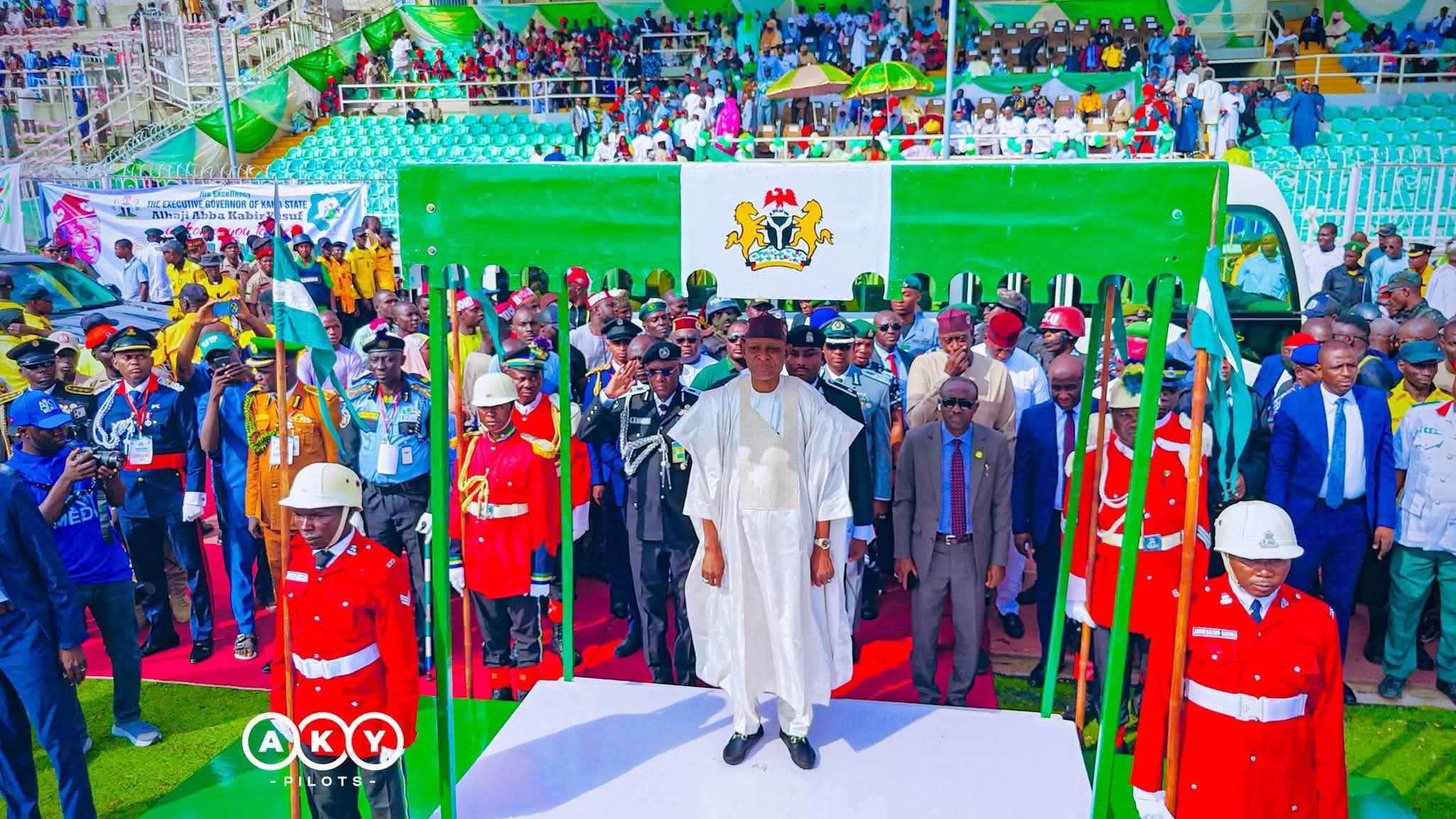
Kano State Governor Abba Kabir Yusuf says his administration has settled approximately N32 billion out of the N48 billion inherited backlog of gratuities and related liabilities owed to retirees in the state.
KANO FOCUS reports that Gov Yusuf disclosed this on Thursday while addressing residents at the 66th Independence Anniversary celebration held at the Sani Abacha Indoor Stadium in Kano.
The governor said the government had also sustained the regular payment of monthly pensions while increasing the minimum monthly pension from N5,000 to N20,000.
He said the welfare of workers and pensioners remained a priority of his administration, citing timely payment of salaries, improved remuneration and measures aimed at strengthening the public service.
According to him, the state has maintained the practice of paying workers’ salaries on or before the 25th of every month while implementing the N71,000 minimum wage for civil servants.
Gov Yusuf also said his administration was sponsoring public servants for professional training, including programmes at the Administrative Staff College of Nigeria (ASCON), to strengthen their administrative and leadership capacity.
He reaffirmed the government’s commitment to building a professional and motivated workforce, while ensuring that the contributions and sacrifices of serving workers and retirees were recognised and treated with dignity.

Kano Govt Orders Retired Civil Servants to Vacate Offices, Hand Over Government Property

Nigeria’s Data Demand Surges 47% as Stakeholders Seek Fresh Investment in Digital Infrastructure

Kano must make government procurement work for made-in-Kano

Kano Settles N32bn Pension, Gratuity Liabilities, Says Gov Yusuf

Family Planning: Experts Urge Nigeria to Remove Barriers to Contraceptive Access

Kano leads again as NECO successes rise to 74,413
Kano tops states in 2026 NECO results, Governor Yusuf hails students

INEC holds campus debate on elections, democracy at BUK

Kano Govt Suspends Durbar Processions, Horse Riding in Metropolis

