
Headlines
NCC, NIPOST explore areas of collaboration


Nasiru Yusuf
The Nigerian Communications Commission (NCC) and the Nigerian Postal Services (NIPOST) have met to discuss key areas of collaborations between the two agencies towards strengthening delivery of their respective mandates and synergising to advance the digital economy agenda of the Federal Government.
This was the highlight of deliberations during a courtesy visit by senior management officials of NIPOST, to the Commission to explore opportunities for collaboration and partnership between the two agencies.
Executive Vice Chairman of the Nigerian Communications Commission (NCC), Prof. Umar Dambatta, who received the NIPOST team led by the Postmaster-General of the Federation, Dr. Ismail Adewusi on Wednesday, said engendering close collaboration and engagement between government agencies remains NCC’s priority.
Prof. Dambatta told the NIPOST delegation that the Commission was committed to fostering synergy and strategic collaboration with relevant Ministries, Departments and Agencies (MDAs) of federal and state government, especially with those sister agencies under the Ministry of Communications and Digital Economy such as NIPOST.

According to him, “This meeting which held at the request of NIPOST is very important as synergy between sister agencies of the government is part of the mandate which the Minister of Communications and Digital Economy, Dr. Isa Ali Ibrahim Pantami has been championing toward deepening truly digital economy in Nigeria.”
While affirming that one of the mandates of NIPOST is to deepen access to certain government services in all the 774 local government areas in the country, Mr Dambatta expressed the Commission’s readiness to support NIPOST with resilient telecom infrastructure that allows the postal agency to jointly contribute to increasing access to financial inclusion in the country.
Prof. Dambatta recalled that, the NCC is actively in collaboration with the Central Bank of Nigeria (CBN) to reduce the number of Nigerians without access to financial services or not more than 20 percent.
“The idea is to raise the financial inclusion penetration from below 60 per cent to 80 percent by end of 2020. That is the target of the Federal Government and all agencies in the Ministry of Communications and Digital Economy are expected to work together, more than ever before, towards deepening the frontier of digital services across Nigeria,” Mr Dambatta said.
Internet connectivity in the rural areas
Earlier in his remark, the Postmaster-General of NIPOST, Dr. Ismail Adewusi, explained that the purpose of the courtesy visit to the Commission was “to strengthen the relationship between both agencies.”
Dr. Adewusi noted that the vision for NIPOST by the Federal Government “is to ensure that it continues to play the role of universal service postage as well as offering auxiliary services such as transportation logistics and financial services.”
He emphasised that NIPOST is part of the active agencies pushing the frontiers of the Financial Inclusion Strategy 2018 of the CBN for the country.
He also stated that NIPOST has been playing more active roles in taking millions of Nigerians in rural communities out of poverty.
According to Dr. Adewusi, the collaboration with the NCC with regard to internet connectivity and broadband penetration is necessary especially in the rural areas where internet access is limited.
Accordingly, he said that both agencies can work together to expand access to the internet, particularly in the rural communities where NIPOST has existing infrastructure.
Dr. Adewusi, therefore, sought collaboration on the provision of access to affordable Information and Communications Technology (ICT) services such as e-government and other e-services to the under served and un-served areas of the country, through the Universal Service Provision Fund (USPF).





Nasiru Yusuf Ibrahim
Nigeria’s Vice President, Kashim Shettima, on Tuesday received a delegation from the Association of Kano Business Community at the Presidential Villa, Abuja, during a thank-you visit to President Bola Ahmed Tinubu.
KANO FOCUS reports that the delegation expressed appreciation to the Federal Government for its support to traders and other victims affected by the recent fire incident that razed several sections of the popular Singer Market in Kano.
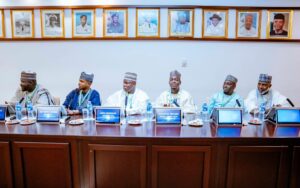
Speaking during the meeting, the Vice President reaffirmed the Federal Government’s commitment to collaborating with the Kano State Government and relevant agencies to prevent a recurrence of fire outbreaks in markets across the state.
He assured the delegation that President Tinubu has the interests of Kano people at heart, noting that the N5 billion approved as immediate relief for victims was based on the findings of a preliminary assessment of the damage caused by the inferno.
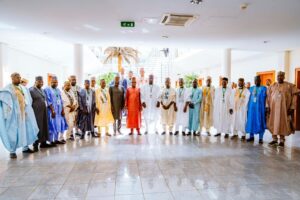
Shettima reiterated that the Federal Government would continue to support efforts aimed at restoring commercial activities and strengthening safety measures in markets to protect lives and property.

Nasiru Yusuf Ibrahim
The Kano State Government has inaugurated a 23-member committee to oversee the transparent and equitable distribution of financial assistance and relief materials to victims of the recent Singer Market fire disaster.
KANO FOCUS reports that the inauguration was carried out on behalf of the Secretary to the State Government, Umar Faruq Ibrahim, who chairs the committee. The event was presided over by the state Attorney-General and Commissioner for Justice, Abdulkarim Kabiru Maude.
According to the Attorney-General, the committee comprises representatives from key government agencies, security services, the Kano Emirate Council, religious leaders, and affected traders.
He said the panel’s mandate includes assessing the extent of losses, verifying genuine victims, ensuring timely distribution of support, and recommending measures to prevent future fire incidents.
The intervention follows support approved by President Bola Ahmed Tinubu, as well as contributions from the APC Governors Forum. It also comes in addition to earlier assistance provided by Governor Abba Kabir Yusuf and the Deputy Senate President, Barau I. Jibrin.
The state government reaffirmed its commitment to supporting victims of the disaster and restoring commercial activities at Singer Market.

Nasiru Yusuf Ibrahim
The Kano State Government has announced Saturday, March 1, 2026, as the commencement date for the Eid-el-Fitr break for all public and private primary and post-primary schools in the state.
KANO FOCUS reports that the announcement, contained in the approved 2025/2026 academic calendar, applies to both day and boarding schools across the state.
According to a statement issued by the Director of Public Enlightenment, Musbahu Aminu Yakasai, parents and guardians of pupils and students in boarding schools are expected to convey their wards home by the early hours of Friday, February 28, 2026.
The statement further explained that boarding school students are to resume on Sunday, March 22, 2026, while day students are to resume on Monday, March 23, 2026.
It added that the second term will continue from Sunday, March 22, 2026, and end on Saturday, April 18, 2026.
The government directed all public and private schools in the state to comply strictly with the directive, warning that non-compliance would be treated as a breach of government instructions.
The Commissioner for Education, Ali Haruna Abubakar Makoda, urged parents and guardians to ensure full compliance with the approved resumption dates.
He appreciated parents and residents of the state for their continued cooperation and support to the ministry, and wished pupils and students a successful completion of the Ramadan fast and hitch-free Sallah celebrations.

Kano business community thanks FG for N5bn Singer market relief

Kano Govt inaugurates 23-member committee to disburse Singer market fire relief

Kano Govt announces March 1 for schools’ Ramadan break

NCC board chair hosts licensed telecoms operators in Lagos

Stakeholders seek stronger nutrition financing at local government level

Lami Maccido, first person to appear on screens of NTA Kano, CTV 67, dies at 72

Governor Yusuf Appoints Acting DG for Pilgrims Board, Names Provost for Anti-Corruption Institute

Kano govt investigates reported disease outbreak in Garko community

K-SAFE appeals to Kano Executive Council to pass revised education bill

