
Headlines
Almajirai become financial operators, as Kayi Microfinance Bank drives financial inclusion in Northern Nigeria


Nasiru Yusuf Ibrahim
KAYI Microfinance Bank has launched a pioneering digital financial inclusion programme designed specifically for Tsangaya Schools (often referred to as Almajiri schools) in Northern Nigeria.
KANO FOCUS reports that this forward-looking scheme aims to bring underserved communities into the digital banking fold, thereby facilitating economic empowerment and social advancement.


By focusing on these informal learning centers, the bank addresses the financial needs of remote populations that have historically found it difficult to access banking services.
Northern Nigeria has long grappled with serious obstacles to widespread financial inclusion. Geography, weak banking infrastructure, and skepticism toward formal financial establishments often deter community members from engaging with traditional banks.

To tackle these hurdles, KAYI Microfinance Bank has rolled out a pilot project in four states—Kano, Katsina, Kaduna, and Jigawa—equipping Tsangaya schools with the training and resources needed to become local champions of digital financial access.
Each participating Tsangaya school receives a comprehensive support package valued at five million naira, which includes extensive training in business management and financial literacy, a POS device, and seed funding. By making it easier for rural residents to deposit, withdraw, and transfer funds right in their neighborhoods, the programme eliminates the need for long-distance travel.
This localized banking model not only increases community trust in formal financial services but also stimulates local economic activity by keeping more money in circulation within these areas.

A key element of the programme is its focus on education and capacity-building. Through collaboration with malams (teachers or overseers) and their students (almajirai), KAYI ensures that essential skills in financial literacy, business management, and customer service are developed at the grassroots. Rather than simply handing out technology, the bank prioritizes the knowledge and skills necessary to sustain and expand these new cash point businesses.
Over time, Tsangaya schools evolve into essential economic hubs in their communities, offering viable alternatives to street begging through entrepreneurship and self-reliance.
KAYI Microfinance Bank sets itself apart by weaving community development into formal financial systems. By integrating its training initiatives with the cultural and educational practices of Tsangaya schools, the bank nurtures a sense of ownership among local participants. Almajirai and malams, previously unfamiliar with modern banking structures, now serve as key financial intermediaries. Their schools become not just centers of Islamic education, but also launching pads for business ventures that uplift entire neighborhoods.
The overarching impact of this initiative will depend significantly on the involvement of policymakers and government agencies. By offering subsidies or other supportive measures through these grassroots-level programmes, government authorities can extend the reach of this successful model to more states in Northern Nigeria.

By blending technology, targeted education, and a deep respect for cultural values, KAYI Microfinance Bank provides a compelling framework for linking rural populations with broader financial systems. Rural dwellers who lacked access to formal banking services now have opportunities to save securely, receive funds quickly, and potentially invest in small enterprises. These transformative changes are expected to help reduce poverty, combat unemployment, and spark local entrepreneurship.
By spotlighting Tsangaya schools as operational examples, KAYI underscores the fact that even the most marginalized communities can adopt forward-thinking financial strategies when they align with local realities. The result marks a new era for Northern Nigeria, where financial inclusion is evolving from a distant goal into a realistic, tangible process—one that holds the promise of lasting prosperity and equity for countless individuals.













Nasiru Yusuf Ibrahim
Nigeria’s Vice President, Kashim Shettima, on Tuesday received a delegation from the Association of Kano Business Community at the Presidential Villa, Abuja, during a thank-you visit to President Bola Ahmed Tinubu.
KANO FOCUS reports that the delegation expressed appreciation to the Federal Government for its support to traders and other victims affected by the recent fire incident that razed several sections of the popular Singer Market in Kano.
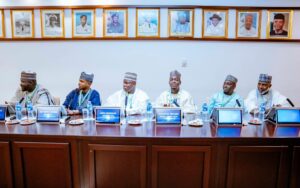
Speaking during the meeting, the Vice President reaffirmed the Federal Government’s commitment to collaborating with the Kano State Government and relevant agencies to prevent a recurrence of fire outbreaks in markets across the state.
He assured the delegation that President Tinubu has the interests of Kano people at heart, noting that the N5 billion approved as immediate relief for victims was based on the findings of a preliminary assessment of the damage caused by the inferno.

Shettima reiterated that the Federal Government would continue to support efforts aimed at restoring commercial activities and strengthening safety measures in markets to protect lives and property.

Nasiru Yusuf Ibrahim
The Kano State Government has inaugurated a 23-member committee to oversee the transparent and equitable distribution of financial assistance and relief materials to victims of the recent Singer Market fire disaster.
KANO FOCUS reports that the inauguration was carried out on behalf of the Secretary to the State Government, Umar Faruq Ibrahim, who chairs the committee. The event was presided over by the state Attorney-General and Commissioner for Justice, Abdulkarim Kabiru Maude.
According to the Attorney-General, the committee comprises representatives from key government agencies, security services, the Kano Emirate Council, religious leaders, and affected traders.
He said the panel’s mandate includes assessing the extent of losses, verifying genuine victims, ensuring timely distribution of support, and recommending measures to prevent future fire incidents.
The intervention follows support approved by President Bola Ahmed Tinubu, as well as contributions from the APC Governors Forum. It also comes in addition to earlier assistance provided by Governor Abba Kabir Yusuf and the Deputy Senate President, Barau I. Jibrin.
The state government reaffirmed its commitment to supporting victims of the disaster and restoring commercial activities at Singer Market.

Nasiru Yusuf Ibrahim
The Kano State Government has announced Saturday, March 1, 2026, as the commencement date for the Eid-el-Fitr break for all public and private primary and post-primary schools in the state.
KANO FOCUS reports that the announcement, contained in the approved 2025/2026 academic calendar, applies to both day and boarding schools across the state.
According to a statement issued by the Director of Public Enlightenment, Musbahu Aminu Yakasai, parents and guardians of pupils and students in boarding schools are expected to convey their wards home by the early hours of Friday, February 28, 2026.
The statement further explained that boarding school students are to resume on Sunday, March 22, 2026, while day students are to resume on Monday, March 23, 2026.
It added that the second term will continue from Sunday, March 22, 2026, and end on Saturday, April 18, 2026.
The government directed all public and private schools in the state to comply strictly with the directive, warning that non-compliance would be treated as a breach of government instructions.
The Commissioner for Education, Ali Haruna Abubakar Makoda, urged parents and guardians to ensure full compliance with the approved resumption dates.
He appreciated parents and residents of the state for their continued cooperation and support to the ministry, and wished pupils and students a successful completion of the Ramadan fast and hitch-free Sallah celebrations.

Kano business community thanks FG for N5bn Singer market relief

Kano Govt inaugurates 23-member committee to disburse Singer market fire relief

Kano Govt announces March 1 for schools’ Ramadan break

NCC board chair hosts licensed telecoms operators in Lagos

Stakeholders seek stronger nutrition financing at local government level

Lami Maccido, first person to appear on screens of NTA Kano, CTV 67, dies at 72

Governor Yusuf Appoints Acting DG for Pilgrims Board, Names Provost for Anti-Corruption Institute

Kano govt investigates reported disease outbreak in Garko community

K-SAFE appeals to Kano Executive Council to pass revised education bill

