
Opinion
A reply to Dan’uwa Rano’s from makafi to awakai: the display of blind plotics and political idolatry

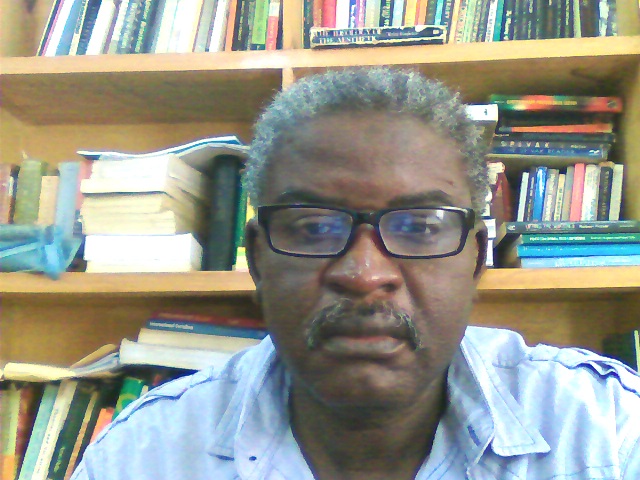
Ibrahim Bello-Kano
I’ve read Danuwa Rano’s post as a trained and professional critic of prose works, both fictional and non-fictional (the kind of writing in which the writer and the narrator are the same person, and in which there is a direct mode of address to the purported reader of the writing, the text). Thus, my response to this post, shared on this platform, is three-fold.
1. The writer, Danuwa Rano, is a well-known member or sympathiser of the APC in Kano and a supporter of an aspiring APC candidate for the position of the Gov. of Kano State, despite his critical yet digressive comment on the Gov of Jigawa, Namadi, Abubakar Rimi, and Aminu Kano, to cite just those three. In my academic field, we train our students in the literary criticism of non-fictional texts to look for the writer’s MOTIVE for writing. Usually, in this kind of writing, the writer does not reveal his motive (which is usually hidden) for writing directly but takes detours, digressions, and other textual strategies of establishing some nuggets of “authenticity”. Just a ploy to deceive the unsuspecting or the gullible reeader, to say the least. If and where the writer is well known, we also seek to read his previous works, including his podcasts, interviews, or open attitudinal-ideological stance in relation to public discourse.
2. We also probe the text for its linguistic “unsaids” or “non-saids”, namely its TONE and the perspectival presentation of events and people (we call this reading or interpretive strategy “symptomatic reading”). It’s interesting that the writer himself reveals that his text was inspired by a previous one critical of Kwankwaso and the Kwankwasiyya movement, written by Auwal Anwar.

3. After a thinly veiled ideological bad faith on the part of Danuwa Rano, he delves into a moralistic discourse, namely that God/Allah has created human beings with dignity and with self-worth, higher than those of the animals such as “goats”; and much more integrative than the blind (“makafi”). But Danuwa Rano is clearly not very educated in how language, in this case Hausa and English, work. In language, in Hausa, we call or regard someone that is a maestro, a highly gifted person, in any vocation or an endeavor, as, or by describing him as “shege” or “maye” in or about something that we admire or value (masterly). Why is that? Language has both DENOTATION and CONNOTATION. In any Hausa dictionary, the denotation of “Shege” would be “bastard” (illegitimate within the marriage-kinship and cultural system). But when used in the context of connotation, “Shege” describes someone with admirable skills, in appreciation of his or her skills, mastery, and distinguished capacities. Alas, this is what Danuwa Rano has missed. So, in every linguistic comminity, symbolism, figuration, and emblematic descriptions are never far away from the symbolic sphere of experience. Here’s another example from the English language. Expressions such as “evil genius” and the Latinate “maestro” exist because symbolisation or figural descriptions are creative, a way of coming into the undecidable space of appreciation and appropriation, including the anxiety about what we denote in the cultural-linguistic game, and in our unconscious.
4. Rather bizarrely and crudely, perhaps even maliciously, Danuwa Rano fails to see, blinded by his ideological moralism, that whenever the Kwankwasiyya people call themselves “makafi” and “awaki” they are, in fact, ENGAGING IN the SYMBOLIC PARODY of their opponents, that is, those who criticise them for being resolute and committed political agents in a certain way. To borrow a metaphor from Michel Foucault, it is the Kwankwasiyya people’s way of “self-presentation” in the political and democratic arena. Indeed, it was the same process at work when the British Workers called themselves “Chartists” (based on their Charter of Demands). But we know that a group of human beings cannot be a List or a Charter. Rather, in language, any group can identify with a colour (“Red” for communists and Marxists; Green for Muslims; or with emblems (the Crescent Moon, The Cross, or the Hammer and Sickle, or just an Effigy; a country’s or a state’s “coat of arms”). Should we assume, then, that the Kwankwasiyya followers are physically, intellectually, or ideologically blind? But if they were, they would not work for someone, Senator Kwankwaso (RMK), that they couldn’t have literally “seen”.
5. Danuwa Rano is such a poor writer, such a poorly educated person on how language and symbolisation actually work, that he mistook a figural statement as intransitively real and factual. What a pity! In fact, I am tempted here to cite the famous argument of the German philosopher, Friedrich Nietzsche, that language as such is only a doxa (opinion) rather than (a) truth (episteme). In this view, language is a kind of rhetoric and thus inherently rhetorical. For example, in the Hausa “Kirari” system, any one can call themselves a lion, a mouse, an elephant, or even a fox, or even, indeed, a “merciless killer”, one who does not and would not spare his enemies. I recall, in my youth, my father admiringly calling my mother “uwar garke” (“the mother of the herd”, his herd) but does that mean she was a cow, the female head of a herd of cows? Certainly not!
6. It is a mark of Danuwa Rano’s ideological project that he mistakes linguistic and symbolic parody for the literal thing. Hence, his weak, unconvincing, and flat moralistic attacks on RMK and the Kwankwasiyya people. The latter are saying that they are deeply committed to their political projects, that they are not the typical political opportunists, fortune chasers, and the “fair weather people” that one finds in the Kano APC. In addition, the Kwankwasiyya “Makafi” are also saying that they see clearly where their principled allegiance lies.
7. If Danuwa Rano were a careful, perceptive thinker or writer of political innuendo, he would have seen something prevalent in the history of Kano since the 18th century, namely the tradition of following religious, sectoral leaders, as seen in the mass of committed followers in Kano of the Tariqa, the Shia, and the Izala, to mention just those three. It’s hard not to find a Kano man or woman that is not openly oriented to those three groups.
8. It is, without a doubt, the same temperament that one still finds in the secular political sphere in Kano. Expecting otherwise in the political sphere of the community is either short-sighted or willful blindness or sheer ignorance, all all three. Or, one might ignore all this in furtherance of his un-stated ideological-political agenda.
9. Let me reiterate a point that I have always argued in public: Senator Rabiu Musa Kwankwaso is, without a doubt, a veritable political leader for many reasons. There is not one politician in Kano today who has the deep and wide charisma as to draw a huge crowd of enthusiastic supporters, with the charm and grace that can score, or in fact has scored, over one million votes in Kano State in the elections. His party’s candidate for Governor scored well over a million votes in the 2023 elections. Even Tinubu lost in Lagos in the 2023 elections (only scored anout 600, 000 votes). For that reason and many others (RMK’s cosmic patience, personal Promesean and Sysipusian endurance, his political sagacity and capacity for brilliant and moving political oratory— the “Ma-a-ha chant”), he is the target of disgruntled enemies, the object of deep malice but that is obscured or hidden as “objective analysis”.
10. But hate him or love him, despite Kwankwasiyya movement or not, one must accept that RMK is simply the modern expression of the new politics that is gripping the imagination of young people and that of perceptive, politically committed intellectuals, those who know what is at stake in the political future of Kano State and Nigeria as a whole.
11. Imagine a political leader, the one whose previously opportunistic followers had deserted when he left office, the man who stayed out of power and elective office for eight years, the man who founded a political party within eight months to the national elections, and yet him and his party swept the board, won virtually all the elective offices, including the Govenorship. I daresay such a man, RMK, is naturally the target of malice, envy, and bruised political egos. Danuwa Rano’s virtuperations on RMK and the Kwankwasiyya movement is one more example of crudely malicious, badly conceived, poorly written attacks on modern Kano’s most successful person and his movement.
Ibrahim Bello-Kano.







Abubakar Shehu Kwaru
There is an adage that behind every successful leader stands a dependable ally—one who offers moral discipline, commitment, ability and an unwavering desire to make meaningful impact. Leadership is rarely a solo endeavour; it thrives on loyalty, sound counsel and shared vision.
It is widely acknowledged that a good leader is one who listens to the views, suggestions and constructive criticism of close associates on matters of socio-economic and political importance. In Kano’s political landscape, one of such tested and proven leaders is Murtala Sule Garo, who has served in various capacities and was presented by the All Progressives Congress (APC) as its deputy governorship candidate in the 2023 elections.
The political milestones recorded by Garo cannot be separated from the dedication, loyalty and strategic support of those around him. Prominent among these trusted allies is Honourable Lamin Sani Kawaji, the current Chairman of the APC Caucus in Nassarawa Local Government Area.
It would not be an exaggeration to describe Honourable Kawaji as one of the key commanders supporting their “grand commander” and youthful political leader, Honourable Garo. For nearly two decades, I have maintained a close and personal relationship with both men, observing firsthand their political evolution and shared journey.
In Honourable Kawaji, I have found an honest and principled leader—hardworking, disciplined, punctual and accountable. He is a man who matches words with action and exemplifies prudence and reliability in public service.
Born and raised in the ancient city of Kano over five decades ago, Kawaji has built an impressive record across various spheres of public life. Despite the inevitable challenges and bottlenecks that accompany political growth, he has remained steadfast—an attribute common to many successful individuals.
Popularly known as “Dan Sani” among admirers, he hails from the respected family of the renowned Islamic scholar, Sheikh Sani Zawiyya of Koki quarters in Kano Municipality. His upbringing laid the foundation for his discipline and commitment to community service.
Honourable Lamin Sani Kawaji was first elected Executive Chairman of Nassarawa Local Government Council in 2013 and was re-elected for a second term in 2016. During his tenure, he initiated policies and programmes that transformed the council, ensuring that residents benefitted from the dividends of democracy.
His administration prioritised improvements in education, healthcare service delivery, infrastructural development, youth and women empowerment, and the creation of a conducive atmosphere for commercial activities. Public service efficiency also received significant attention under his leadership.
Like his political ally and mentor, Honourable Garo, Kawaji also served as the Kano State Chairman of the Association of Local Governments of Nigeria (ALGON), further strengthening his credentials in grassroots governance.
Upon the expiration of his tenure as Executive Chairman, the then Governor of Kano State, Abdullahi Umar Ganduje, appointed him Special Adviser on Local Government and Chieftaincy Affairs. Following Garo’s nomination as the APC deputy governorship candidate alongside Nasiru Yusuf Gawuna in 2023, Kawaji was appointed Commissioner for Local Government and Chieftaincy Affairs to replace him in the ministry.
In that capacity, he performed beyond expectations, consolidating reforms and sustaining administrative efficiency.
Political observers will recall that Garo and Kawaji played significant roles in the APC’s 2019 electoral success, which secured a second term for Governor Ganduje and his deputy.
Today, Honourable Kawaji remains a grassroots politician committed to complementing governance efforts in Kano State, including developmental initiatives under the present administration of Abba Kabir Yusuf.
Indeed, the partnership between Honourable Lamin Sani Kawaji and Honourable Murtala Sule Garo demonstrates the enduring value of loyalty, teamwork and shared political vision. With faith, perseverance and strategic collaboration, their journey in public service continues to reflect the timeless maxim: one with God is always in the majority.
Abubakar Shehu Kwaru is a seasoned journalist who writes from Mandawari Quarters in Gwale Local Government Area of Kano State.
Opinion
2027 begins in Kano: Abba Kabir Yusuf formally received into APC as Tinubu consolidates northern political stronghold

Lamara Garba
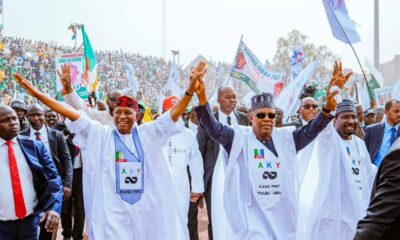
From the moment Vice President Kashim Shettima touched down at Malam Aminu Kano International Airport, the ancient city shifted into a different rhythm. The roads leading from the airport were not merely crowded; they were alive. Traders, market women, civil servants, and artisans abandoned their stalls and workplaces for a glimpse of the visiting dignitaries. Young men climbed rooftops and signposts, while elderly men in flowing babbar riga stood shoulder to shoulder with restless students waving party flags.
The chants rolled like thunder along Airport Road, through Fagge quarters, down Murtala Mohammed Way, and into the arteries leading to the city’s historic heart. It was not the choreography of hired enthusiasm; it was organic, loud, and unmistakable.
By the time the convoy approached the iconic Sani Abacha Stadium, the streets had become a river of humanity. The stadium itself seemed too small to contain the emotion that poured into it. In that moment, one truth stood firm: this was no routine political reception. It was a public declaration of belonging — that Governor Abba Kabir Yusuf belongs to the people of Kano, and that the people, in turn, belong to him.
The formal reception of Governor Yusuf by the national leadership of the All Progressives Congress (APC) was described as a homecoming. Yet it felt deeper — almost philosophical. At its highest form, politics is about alignment: of interests, of vision, of destiny. On that day, Kano appeared to signal that its destiny must sit at the table where national decisions are shaped.
Representing President Bola Ahmed Tinubu, Vice President Shettima addressed the sea of supporters with deliberate clarity. Kano, he noted, is too strategic to stand at the margins of Nigeria’s future. His tone carried both political calculation and historical awareness. Kano has always been more than a state; it is a compass. When Kano moves, Nigeria feels it. When Kano speaks, the federation listens.
His remarks were not mere pleasantries. They underscored the significance of Governor Yusuf’s entry into the APC — not as a simple addition, but as the strengthening of a pillar. Kano’s economic vibrancy and political consciousness, he suggested, are integral to the broader national development agenda.
The Chairman of the Progressive Governors’ Forum, Hope Uzodinma, described Yusuf’s defection as a return home. In politics, the language of homecoming is potent; it softens rivalry and reframes past tensions as steps toward reunion. Uzodinma went further, calling Kano the “brain” of Nigerian politics — a metaphor that resonated deeply with the crowd. A brain directs, calculates, and interprets. By that logic, Kano’s alignment with the APC signals direction for the country.
Similarly, the party’s National Chairman, Nentawe Yilwatda, portrayed the moment as an infusion of fresh momentum. He spoke of progressive ideals and shared responsibility, emphasising that the governor’s entry would enrich rather than dilute the party’s character.
Standing like an elder statesman observing the unfolding of history, former National Chairman Abdullahi Umar Ganduje declared the party in Kano stronger and more united than ever. In Kano’s political theatre, unity is currency. His words suggested that previous fractures had been stitched into a single fabric.
Yet beyond the speeches was the quiet but powerful statement made by the crowd itself. No script can manufacture such enthusiasm. Thousands who lined the streets and filled the stadium were not merely witnessing a political transaction; they were affirming their governor. Their presence was a reminder that leadership, ultimately, is validated by followership.
Governor Yusuf balanced gratitude with principle. He pledged that his new political alignment would not compromise his pursuit of fairness and justice. Defections often invite suspicion, but he framed his decision as pragmatic rather than opportunistic — a strategic move to widen the channels through which Kano’s aspirations could be realised.
There was symbolism, too, in the earlier announcement of federal support for Kano’s recovery from recent challenges. The financial backing from the federal government and the governors’ forum was presented not merely as relief but as evidence of partnership. In politics, resources often follow relationships. By stepping into the APC fold, Kano was not simply changing party colours; it was strengthening its access to the levers of federal influence.
What unfolded at the stadium was layered. On the surface, it was a mega rally filled with music, banners, and applause. Beneath that surface, it was a recalibration of political equations ahead of 2027. Kano’s electoral weight can tilt national outcomes. Any party that secures Kano secures more than votes; it secures narrative dominance in the North.
Philosophically, the event underscored a timeless truth about power: it abhors isolation. In a federal system as complex as Nigeria’s, alignment between state and centre often determines the pace of development. The rally conveyed a shared understanding that Kano’s ambitions are best pursued in concert with the ruling party at the national level.
As the sun dipped over the ancient city and the crowds gradually dispersed, one could sense that something had shifted. Kano had spoken — not in whispers, but in waves. Whether history will judge the decision kindly remains to be seen. But on that Monday in February, the message was unmistakable: the political map of Kano had been redrawn, and the ink was still fresh.
Lamara Garba, a veteran journalist, writes from Kano.
Isyaku Ibrahim
It has become increasingly apparent that whenever the holy month of Ramadan approaches, the Muslim community begins to experience severe electricity outages.
Despite repeated assurances by the relevant authorities year after year, the situation continues unabated. The current circumstances clearly demonstrate this troubling pattern, imposing additional hardship on residents at a time when the community is only hours away from commencing the sacred month-long period of worship.
One may recall that during the late President Umaru Musa Yar’Adua’s administration, a minister once vowed upon assuming office to resolve the persistent electricity challenges to ensure that Muslim faithful could observe Ramadan without power disruptions. Unfortunately, that promise ultimately proved to be a pipe dream.
It is both disappointing and painful that a section of the community appears to bear the brunt of these outages during a spiritually significant period, especially in a secular society where public services are expected to be delivered equitably.
Public utility institutions such as the Kano Electricity Distribution Company (KEDCO) were established to serve the collective interest of all citizens, irrespective of religious, ethnic, sectional, or political affiliations. When that core objective is undermined, it creates frustration, erodes trust, and fosters resentment within the broader society.
Ramadan is a period of reflection, sacrifice, and devotion. It is also a time when families require stable electricity for basic needs—especially for preparing meals to break the fast and to sustain worshippers during long days of fasting. The inability to access reliable power during such a critical time deepens hardship and diminishes the comfort of an already demanding spiritual exercise.
As the holy month begins, it is my sincere hope that KEDCO and other relevant authorities will take urgent and practical steps to ensure improved electricity supply. Ramadan should be a time of spiritual upliftment—not avoidable suffering caused by preventable service failures.
Isyaku Ibrahim is a Director in Kano Civil Service.

Kano business community thanks FG for N5bn Singer market relief

Kano Govt inaugurates 23-member committee to disburse Singer market fire relief

Kano Govt announces March 1 for schools’ Ramadan break

NCC board chair hosts licensed telecoms operators in Lagos

Stakeholders seek stronger nutrition financing at local government level

Lami Maccido, first person to appear on screens of NTA Kano, CTV 67, dies at 72

Governor Yusuf Appoints Acting DG for Pilgrims Board, Names Provost for Anti-Corruption Institute

Kano govt investigates reported disease outbreak in Garko community

K-SAFE appeals to Kano Executive Council to pass revised education bill

