
Headlines
Critics of Almajiri ban are anti-development–Ganduje

Nazifi Dawud
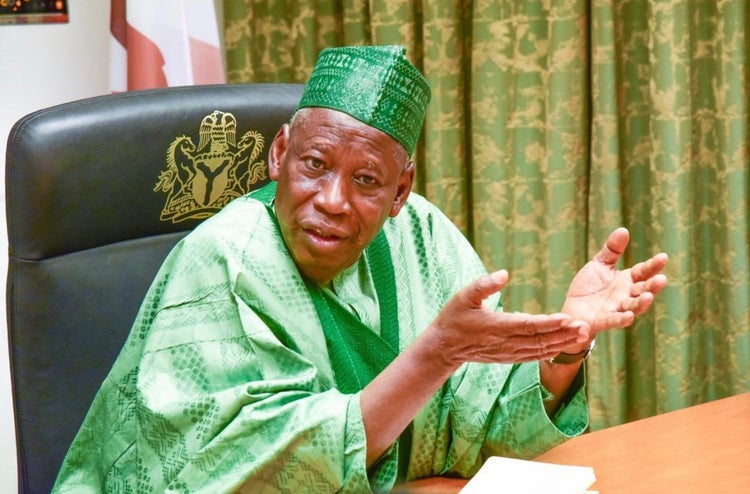
Governor Abdullahi Umar Ganduje has described those who criticize his decision to ban child beggars (almajirai) from roaming the streets across Kano state as “anti-development and anti-people.”
KANO FOCUS recalls that Mr Ganduje had pronounced the proscription of almajirai in the state last Tuesday, and vowed to arrested and prosecute parents who allow their children to roam the streets, begging for food in the name of seeking Islamic knowledge.
Almajirai menace: Kano bans child beggars, to prosecute errant parents
However, the governor was criticized by the Kano Council of Ulama, led by Sheikh Ibrahim Khalil, who said the policy could not succeed “without the consultation and inclusion of stakeholders.”

Kano Council of Ulama rejects Ganduje’s Almajiri ban
It’s wrong for Islamic scholars to attack Ganduje over Almajiri ban–Pantami
But speaking on Sunday during a visit to some Tsangaya schools in Bagwai, Madobi and Bunkure local government areas of the state, Mr Ganduje said begging is un-Islamic and insists on implementing the ban policy.
“Begging is poverty-driven as a result of lack of parental care and lack of societal care. We must take the responsibility of our children,” the governor was quoted in a statement by Abba Anwar, his chief press secretary.
“As we born them, Allah places such responsibilities on our shoulders. Those kicking against our policy are anti-development and anti-people. Or they even lack proper understanding of the position of Islam on begging,” he added.
Mr Ganduje explained that his visit to the Tsangaya schools was part of the steps taken to implement the almajirai proscription.
“The visit was as part of the final touch for the full scale take-off of our banning of begging in the state. Begging is banned and will remained banned. We are telling these beggars to leave begging forever. And we are committed to see to the implementation of this.
“When we capture these beggars we take them to these facilities and take good care of them, we give them education, feed them and look after their living condition,” the governor said.
According to the statement “each of the facilities visited by the governor could accommodate thousands of Almajiris and there are 12 similar facilities across some local governments in the state. Each facility has dormitory, hostels, cafeteria, thousands of toilets, staff quarters among others.”
“We employed over 8,000 teachers recently that would be send to such schools. These children would also be given training on skills acquisition. So that they would become self-independent.
“Those begging in the street as we take them off the street we will take them to those newly established Tsangaya schools.
“We keep them there give them Qur’anic education, English language, Mathematics and Arabic language for them to understand the meaning of the what they are reading, the Holy Qur’an.”
“The second strategy is, those that are under their guardians, we will enrol them into nearby primary schools. And after finishing their primary education we will take them to secondary schools also.”
“Those with thousands of Almajiris would be integrated also into out free and compulsory education system.
“While at the same time government will continue to provide the schools with foodstuffs and some amount of logistics for them to take care of the children. That we have already started with some pilot Almajiri schools. And we are improving the facilities to be healthy,” Mr Ganduje further explained.



Headlines
NAHCON Secures ₦19 Billion Cost Reduction for 2026 Hajj, Pilgrims to Save Over ₦200,000 Each

Mukhtar Yahya Usman
The National Hajj Commission of Nigeria (NAHCON) has announced a ₦19 billion cost reduction for the 2026 Hajj, following a successful negotiation with Saudi service providers and Nigeria’s State Pilgrims’ Welfare Boards.
Chairman of the Commission, Professor Abdullahi Sale Usman, disclosed this while briefing journalists in Kano on the outcome of his recent official visit to Saudi Arabia. He explained that the deal translates to a direct saving of more than ₦200,000 per pilgrim. Nigeria has been allocated 66,910 Hajj slots for the 2026 pilgrimage.
During the visit, NAHCON signed key service contracts with Mashariq Dhahabiyya for Masha’ir operations and Daleel Al-Ma’aleem for transportation. It also secured better accommodation and feeding arrangements in the Markaziyya area of Madinah at competitive rates.
Professor Sale further announced the official fares for the 2026 Hajj as follows:
Maiduguri/Yola: ₦8.12 million
Other northern states: ₦8.24 million
Southern states: ₦8.56 million
He stressed that State Pilgrims’ Welfare Boards must remit 50 percent of the fares by October 8, 2025, while full payments from intending pilgrims are due by December 31, 2025.
“The deadlines are critical to enable early bookings and smooth operations,” he said, reaffirming NAHCON’s commitment to delivering a hitch-free Hajj exercise in 2026.
The NAHCON boss also appealed to the media for sustained support in sensitizing the public, noting that effective collaboration will ensure that the commission achieves its goals for Nigerians

… As Gov. Yusuf Condemns CP Bakori’s Partisan Conduct
… Demands His Immediate Removal for Sabotage, Unethical Behaviour
Kano State Governor, Alhaji Abba Kabir Yusuf, has condemned in the strongest terms the unprofessional and partisan conduct of the Kano State Commissioner of Police, Ibrahim Adamu Bakori, describing his actions as deliberate sabotage against the people of Kano and the Nigerian state.
In a statement issued by his spokesperson, Sunusi Bature Dawakin Tofa, the governor expressed outrage over the sudden withdrawal of police participation from the 2025 Independence Day celebration in Kano — an order CP Bakori issued just hours before the commencement of the event.
Governor Yusuf said the action was a clear demonstration of bias, insubordination, and betrayal of the Nigeria Police Force’s constitutional duty.
“As the Chief Security Officer of Kano State, we cannot tolerate sabotage to the peace, security, and wellbeing of our citizens. It is disgraceful that a Commissioner of Police would descend so low into partisan politics by boycotting a national event that symbolizes unity, patriotism, and democracy,” Governor Yusuf stated.
The governor accused CP Bakori of consistently aligning with political interests opposed to the will of the people of Kano, thereby eroding public trust in the police command. He described the CP as a “political police officer” who has abandoned professionalism and is actively undermining democracy.
“The police must never be seen as tools of politicians. They are expected to protect all Nigerians, regardless of political leanings. Unfortunately, CP Bakori has turned himself into a willing instrument of division and insecurity in Kano State,” the statement added.
Governor Yusuf therefore led the voices of Kano stakeholders who were present at the 2025 Independence Day Celebration at Sani Abacha Stadium, Kofar Mata, in calling on President Bola Ahmed Tinubu to direct the Inspector General of Police to immediately remove CP Bakori from office and replace him with a competent and non-partisan officer who will restore confidence, fairness, and neutrality in policing Kano State.
The stakeholders who joined their voices with that of the Governor included traditional and religious leaders, NNPP members of the state and national assemblies, the business community, youth groups, and labour organizations.
The governor reaffirmed his administration’s commitment to protecting the lives and properties of the people, stressing that no act of sabotage from compromised security officials will succeed in destabilizing Kano under his watch.
He also commended the efforts of other security agencies in the state — with the exception of the police.
Governor Yusuf appreciated the leadership of the state commands of the Nigeria Customs Service, Nigeria Immigration Service, Nigeria Correctional Service, Federal Fire Service, and the State Directorate of Security Services, all of whom participated in the 2025 Independence Parade.

Aminu Abdullahi Ibrahim
Dr. Musa Mohammed Bello, State Focal Person for the African Health Budget Network (AHBN), announced significant progress in a Gavi-funded immunization project implemented in collaboration with the African Field Epidemiology Network (AFENET) across Sokoto, Kano, Bauchi, and Borno states since September 2023.
KANO FOCUS reports that the project has recorded notable reductions in the number of zero-dose children those who have not received any vaccines particularly in Kano, where 15 local governments were identified as high-burden areas.
During a recent review meeting focusing on Kano State, stakeholders assessed successes and challenges related to immunization budget allocation, vaccine supply chain disruptions, cold chain management, and access to immunization services by parents and caregivers.
Dr. Bello commended the Kano State government for consistently allocating above 15% of the budget to health surpassing the Abuja Declaration recommendation but pointed out issues with approval and release of funds that hinder smooth project implementation.
He also stressed the need for Kano State to reduce its heavy reliance on donor funding from partners such as WHO, UNICEF, and the Bill & Melinda Gates Foundation by strengthening local counterpart contributions. Isyaku Lawan Dawakin from Kano State Bureau of Statistics emphasized the value of peer learning activities to close knowledge gaps and boost vaccine outreach.
Dr. Bello further highlighted the strengthening of advocacy and government relationships through the 2023-2024 Accountability Scorecard initiative, which has enabled better communication and cooperation with key government committees on health and appropriation. Evidence-based advocacy built on decentralized immunization monitoring assessments by AFENET has helped identify specific challenges at the local government and health facility levels, informing targeted interventions.
He presented recent data from September 2025 showing high reporting rates from primary health care facilities on routine immunization services via SMS across the targeted local governments, reflecting increased monitoring and responsiveness. The project has fostered deeper understanding of the budgetary process among civil society and health stakeholders, contributing to increased awareness and coordinated action to address zero-dose children.
Crucially, Dr. Bello revealed that Kano State has seen a tremendous decrease in zero-dose children—from over 539,000 in 2020 to around 120,000 by December 2024—attributed to collaborative government and partner efforts.
This achievement underscores the positive impact of strengthened immunization systems, accountability frameworks, and partner coordination in improving child health outcomes across the region.
”This initiative forms part of a broader push to improve immunization coverage and accountability in West Africa, aiming to ensure that no child is left unvaccinated and vulnerable to preventable diseases,” he said.
Isyaku Lawan Dawakin Tofa from Kano State Bureau of Statistics emphasized the value of peer learning activities to close knowledge gaps and boost vaccine outreach.

BPSR Ranks NCC among Top 3 MDAs in Best Website Performance in 2025

Quality of Service Challenges in Abuja

BEC Ranks NCC Among Top Five Best-Performing Government Agencies in 2025

Dangote Cement commissions 100 Billion CFA Francs Cement Plant in Côte d’Ivoire Cement Plant

