
News
Danbatta Lauds Swedish Government, Ericsson for Sustained, Remarkable Partnership


Nasiru Yusuf Ibrahim
The Executive Vice Chairman and Chief Executive Officer (EVC/CEO) of the Nigerian Communications Commission (NCC), Prof. Umar Garba Danbatta, has commended the Swedish Government and Ericsson for their commitment and consistency in a strategic partnership with NCC on capacity building which has strengthened the Commission’s regulatory activities.

Speaking at a workshop jointly organised by NCC and its Swedish partners within the framework of the Swedish Programme for Information and Communications Technology (ICT) in Developing and Emerging Regions (SPIDER), Danbatta stressed the significant strides made by NCC in the field of ICT.
“This workshop signposts the vital role the Nigerian Communications Commission, as a regulator, has been playing in the West African sub-region. It also highlights the unending objective of keeping up with the times and ever-evolving dynamics of the telecommunications sector,” Danbatta stated.
The NCC Chief Executive reiterated the enduring commitment of the Swedish Government and SPIDER to the cause of ICT development in emerging regions and acknowledged their roles in improving access to healthcare, education, income generation, and employment opportunities in West Africa, thereby contributing to poverty reduction.
“This periodic strategic engagement under the auspices of SPIDER over the years has made the Commission a more effective regulator and enhanced it contribution to the development of the telecommunications sector. This contribution will further support the creation of an ecosystem that is beneficial to the economies and people of the region,” the EVC said.
In her speech, the Swedish Ambassador to Nigeria, Ghana, Cameroun, and Economic Community of West African States (ECOWAS), Mrs. Annika Hahn, highlighted the significance of ICT regulation and capacity building as key drivers for economic development and social progress.
The ambassador also commended the NCC for hosting the event and fostering collaboration between the two nations. She acknowledged the pivotal role ICT has played in Sweden’s economic growth being the birthplace of Ericsson, one of the world’s oldest and largest ICT companies, with a rich history in the sector.
Speaking further, the ambassador stressed the global technological revolution and its potential to catalyse industrial and economic development. She stressed the need for modern and adaptable regulation to navigate this rapidly-evolving landscape.
Hahn also stated that, “to cope with this new and swiftly-developing environment, we need to regulate in a modern and adaptable way. Therefore, human capacity building in ICT regulation is crucial for all of us.”
The diplomat said the COVID-19 pandemic accelerated the adoption of ICT across the globe, leading to an increase in Internet users as the shift impacted various sectors, including education, commerce, and financial services. She also said that e-learning practices on various platforms played a significant role in the transformation.
Speaking further, the Ambassador said Ericsson has reported that there were more than 900 million registered mobile subscriptions in Sub-Saharan Africa in 2022, with a considerable portion of those in Nigeria.
The Swedish ambassador said that, in driving growth and contributing to the ambitious goal of over a billion mobile subscriptions by the end of 2023 within Sub-Saharan Africa, “education must be an essential part of our regulatory development strategies and policies, hence the need for collaboration in knowledge-sharing and up-skilling of human resources by all stakeholders.”


Nasiru Yusuf Ibrahim
Kano State Governor, Alhaji Abba Kabir Yusuf, has appointed renowned public health expert, Dr. Aminu Garba Magashi, as Co-Chair of the Kano State Anti-Drug Abuse Task Force in a renewed effort to combat substance abuse and related social vices across the state.
KANO FOCUS reports that the appointment was announced in a statement issued on Monday by the Director-General, Media and Publicity, Government House, Kano, Sunusi Bature Dawakin Tofa.
According to the statement, the appointment underscores the administration’s commitment to strengthening collaboration with civil society organisations, public health professionals and other stakeholders in tackling the growing menace of drug abuse, particularly among young people.
Governor Yusuf also disclosed plans by the state government to establish a mobile court dedicated to the speedy prosecution of drug-related offences and other social crimes.
He said the initiative is aimed at ensuring swift justice, strengthening law enforcement and serving as a deterrent to offenders.
The governor expressed confidence that Dr. Magashi’s extensive experience in public health policy, social protection and community development would enhance the effectiveness of the task force and support the government’s efforts to build a safer, healthier and drug-free Kano.
Dr. Magashi is the President of the Africa Health Budget Network and a respected civil society advocate with decades of experience in healthcare, public policy and community development.
As part of efforts to strengthen the task force, Governor Yusuf also approved the inclusion of a representative of the Kano State Sharia Commission in its membership to ensure that its activities conform with Islamic guidance.
The state government said the latest measures form part of broader efforts to address drug abuse, improve public safety and protect communities from the social and economic consequences of substance abuse.

Nasiru Yusuf Ibrahim
Kano State Governor, Alhaji Abba Kabir Yusuf, has called on conventional and social media practitioners to promote factual reporting, patriotism and active citizen participation as part of efforts to deepen democracy and strengthen public trust.
KANO FOCUS reports that the governor made the call on Monday while declaring open the maiden Arewa Media Summit held at the Coronation Hall, Government House, Kano. The summit was organised by the Office of the Senior Special Assistant to the President on Media and Public Enlightenment in collaboration with the Kano State Government.
A statement issued by the Governor’s Chief Press Secretary, Mustapha Muhammad, quoted Governor Yusuf as saying that the media must remain committed to truth, bridge generational divides, amplify the voices of the people and encourage responsible civic engagement.
He described the theme of the summit, Government, Citizens’ Accord, Accountability, Responsibility and Ethical Media Practice, as timely, noting that it provides an opportunity to strengthen governance, accountability and public confidence through ethical journalism.
According to the governor, responsible journalism and access to credible information are critical to national development and the successful implementation of government policies and reforms.
Governor Yusuf said his administration has continued to support media development by protecting press freedom and creating an enabling environment for journalism to thrive.
He listed the establishment of Northern Nigeria’s first Online Media Chapel, sponsorship of information officers for registration with the Nigerian Institute of Public Relations (NIPR), and the registration of journalists with the Nigerian Society of Broadcasters (NSB) among the state’s achievements in advancing professional journalism.
The governor also commended the Minister of Information and National Orientation, Mohammed Idris, for strengthening information management across the country, and praised the Senior Special Assistant to the President on Media and Public Enlightenment, Abdulaziz Abdulaziz, for promoting professionalism and ethical journalism through the summit.
In his remarks, the Minister of Information and National Orientation said the future of Northern Nigeria depends not only on investments in infrastructure and agriculture but also on credible journalism, responsible communication and effective storytelling.
Also speaking, Abdulaziz Abdulaziz said the summit was organised to promote accuracy, fairness and professionalism in reporting government activities while strengthening the relationship between government, citizens and the media.
Delivering the vote of thanks, the Director-General, Media and Publicity, Government House, Kano, Sunusi Bature Dawakin Tofa, said Governor Yusuf’s sustained investment in the training and retraining of media practitioners has enhanced journalism practice in the state.
KANO FOCUS reports that the summit attracted the Deputy Governor of Kano State, Alhaji Murtala Sule Garo, ministers, lawmakers, academics, media professionals and participants from across Northern Nigeria.
News
Kano launches free 48-hour emergency treatment scheme for accident victims, other critical cases
Nasiru Yusuf Ibrahim
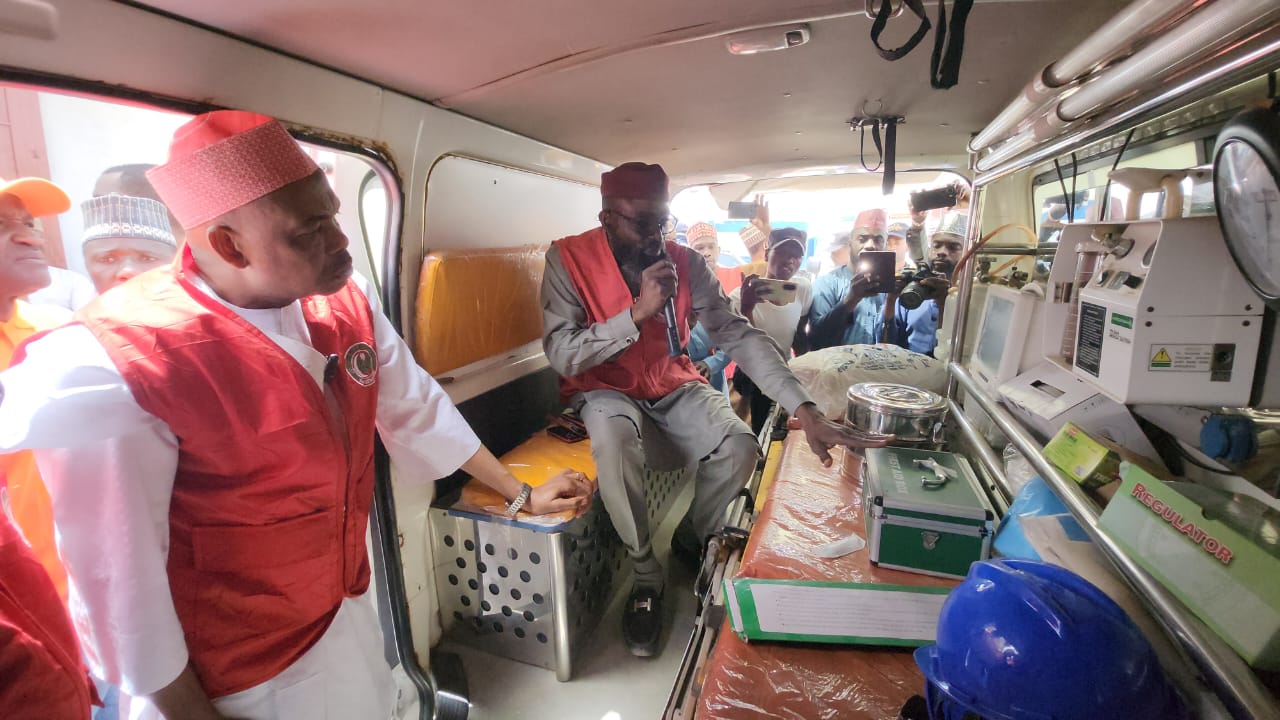
The Kano State Government has introduced a free emergency medical treatment programme that provides eligible patients with lifesaving care for the first 48 hours at designated hospitals across the state.
KANO FOCUS reports that the initiative, being implemented through the Kano State Emergency Medical Services and Ambulance System (KN-SEMSAS) under the Ministry of Health, is designed to ensure that victims of medical emergencies receive prompt treatment without financial barriers.
According to information released by the state government, the scheme covers children under the age of five, including newborns with emergency conditions, road traffic accident victims, gunshot injuries, snakebite cases, drowning incidents, fire-related injuries, building collapse victims, communal clash casualties and other weapon-related injuries.
The programme also includes obstetric and neonatal emergency referrals from Kano State’s 18 MAMII local government areas through the SaveMAMA referral system.
Under the initiative, emergency treatment is provided free of charge for the first 48 hours at accredited Emergency Medical Treatment Centres (EMTCs) across the state.
The government advised patients or their relatives to contact the KN-SEMSAS Emergency Call Centre before or immediately upon arrival at an accredited hospital to obtain an authorisation code, while stressing that emergency treatment should not be delayed while the code is being processed.
Residents were urged to use the national toll-free emergency line 112 or the state’s dedicated emergency numbers 09019999920 and 09049999914 to request ambulance services and access the programme.
The accredited hospitals participating in the scheme include Aminu Kano Teaching Hospital (AKTH), National Orthopaedic Hospital, Dala, Muhammad Abdullahi Wase Teaching Hospital (MAWTH), Murtala Muhammad Specialist Hospital, Sir Muhammad Sanusi Specialist Hospital, Sheikh Muhammad Jidda General Hospital, Waziri Shehu Gidado General Hospital, MDS Hospital, Zak Clinic, MGK Hospital and Khadijat Memorial Hospital.
The state government said the initiative forms part of ongoing efforts to strengthen emergency healthcare delivery and improve access to lifesaving medical services for residents.
It called on members of the public to take advantage of the programme and share information about the emergency treatment scheme to enable more residents to benefit from the free services.

Gov. Yusuf appoints Dr. Aminu Magashi co-chair of Kano anti-drug abuse task force

Gov. Yusuf tasks media on truthful reporting, patriotism

Kano launches free 48-hour emergency treatment scheme for accident victims, other critical cases

K-SAFE hails Gov. Yusuf as Kano tops ECOWAS education spending ranking

Abdulaziz unveils project inspection initiative, trains APC social media inflluencers at Arewa media summit
Kano ranks best in ECOWAS on education spending index

Kano recruits over 16,000 teachers, begins 10-year education reform plan
Kano emerges top beneficiary as World Bank rewards states with $27m for reforms

Kano delegation participates in international labour conference in Geneva

