
Opinion
Abba Kabir Yusuf: Loyalty, Leadership and the Burden of Choice


Abdulkadir A. Ibrahim (Kwakwatawa), FNGE,
Governor Abba Kabir Yusuf’s eventual defection was not an act of ambition or betrayal, but a calculated decision shaped by loyalty, patience and the overriding necessity of governance. His journey reflects the difficult balance between ideology and responsibility in Nigeria’s political terrain.

Politics is not merely a contest for power; it is a discipline of choice. It is a terrain where patience is tested, loyalty is strained, and leadership is measured not by noise but by consequence. Within this demanding landscape, the delayed defection of Governor Abba Kabir Yusuf did not arise from indecision, opportunism or personal ambition. Rather, it emerged from a deliberate and sustained effort to align loyalty with strategy, principle with progress, and mentorship with the realities of governance.
From the very beginning, Abba Kabir Yusuf’s political life has been defined by obedience and restraint. His rise was neither abrupt nor rebellious. He operated firmly within the shadow of his political mentor, Senator Rabi’u Musa Kwankwaso, absorbing the ethos of movement politics, where discipline outweighs impulse and structure takes precedence over personal will. Even as governor of Kano, one of Nigeria’s most politically significant states, Abba remained ideologically grounded in the belief that leadership must not outgrow loyalty.
Yet politics evolves, and governance confronts leaders with questions that ideology alone cannot answer.
Governor Abba’s delay in defecting to the APC was rooted in a singular objective: he wanted Kano’s political realignment to be collective, dignified and anchored around his mentor. On several occasions, he made deliberate and quiet efforts to soften Kwankwaso’s stance, urging him to look beyond rigid demands and towards broader possibilities of national alignment. Abba understood what many pretended not to see — that Kwankwaso’s value in Nigerian politics was already established and did not require transactional bargaining to be affirmed.
In this pursuit, Abba became more than a governor; he became a bridge. His travels, both local and international, were not personal adventures but diplomatic missions. The planned meeting in France, subsequent engagement attempts in the UAE, and the eventual discussion with President Bola Ahmed Tinubu in Abuja were all part of a calculated effort to create neutral ground for dialogue. Each step reflected Abba’s belief that reconciliation must be pursued persistently, even when outcomes are uncertain.
It is no longer a secret that political restructuring within the APC, including the removal of Dr Abdullahi Umar Ganduje as National Chairman, was widely interpreted as an opening gesture towards Kwankwaso. The intention was clear: to create space, reduce friction and encourage reintegration. Yet, despite these overtures, the response remained distant. Even when a direct meeting between President Tinubu and Kwankwaso was proposed after Abba’s engagement with the President, it was deliberately declined.
At the heart of the impasse was rigidity. The insistence that any return to the APC must be predicated on a vice-presidential ticket revealed a fundamental misreading of political timing.
While Kwankwaso remains charismatic, influential and a proven crowd mobiliser, succession politics is not dictated by entitlement but by alignment, trust and gradual consensus. Abba saw this clearly and repeatedly counselled moderation, patience and realism.
Throughout this period, Abba Kabir Yusuf endured in silence. He absorbed political marginalisation within his own movement without public complaint. He exercised little or no influence over party structures, candidate selection or even local government political arrangements. Yet, despite these constraints, he never uttered a single negative word against his mentor. On the contrary, he publicly warned commentators and social media actors against disparaging Kwankwaso. This was not weakness; it was character.
However, governance eventually demands a reckoning.
Kano State could no longer afford political isolation. Development, security, infrastructure and economic revival require synergy with the centre. The cost of standing apart had become too visible to ignore. The Wuju-Wuju road project stands as a powerful symbol of this reality. Conceived during Kwankwaso’s tenure at an estimated cost of about ₦5 billion, the project languished for years in abandonment. Today, through federal intervention, the same project is being revived at a staggering cost of ₦46 billion. This is not merely inflation; it is the price of delay, distance and political disconnection.
For Abba Kabir Yusuf, this was the turning point. “Kano first” ceased to be a slogan and became a moral imperative. Development cannot be sentimental. Security cannot be postponed. Governance cannot wait for perfect alignment when the people are paying the price of political stasis. His defection to the APC, therefore, was not a rejection of loyalty but an expansion of responsibility.
Even in changing course, Abba remained faithful to his values. He left without insults, bitterness or revisionist attacks on his past. His silence spoke louder than any justification. It reflected a leader who understands that respect does not end where agreement fails — humble, gentle and courteous.
In the final reckoning, politics must answer to morality, and morality must answer to consequence. Leadership is not validated by how long one waits, but by when one chooses to act. Governor Abba Kabir Yusuf’s decision reflects a timeless truth: when loyalty begins to delay collective progress, conscience must intervene. Kano’s future could not remain hostage to prolonged negotiations or rigid postures, no matter how noble their origins.
History is unkind to leaders who confuse patience with prudence. It remembers those who understand that power is a means, not an inheritance, and that alignment is not surrender when it unlocks development, security and dignity for the people. Abba’s choice affirms that governance is a trust — one that demands difficult decisions taken with humility and restraint.
In choosing Kano first, prioritising peace, unity and progress over comfort, action over endless persuasion, and responsibility over sentiment, Abba Kabir Yusuf has placed himself on the harder side of leadership. And it is often on that harder side that the future is quietly secured.
Abdulkadir A. Ibrahim (Kwakwatawa), FNGE, is a veteran journalist and public affairs analyst. He writes from Kano.






Saleh Adamu Kwaru
The milestone of Nigeria’s foreign exchange reserves crossing $54.08 billion for the first time in nearly 18 years reads like a triumphant headline. On paper, it represents a towering financial fortress built by the Central Bank of Nigeria through steady oil revenues, aggressive monetary tightening, and unprecedented diaspora inflows. Yet, beneath these dazzling macroeconomic figures lies a deeply agonising paradox. For the average Nigerian, the euphoria of $54 billion in the vault feels less like a shared national victory and more like a cruel illusion—a distant celebration taking place in glass towers while the everyday citizen fights an exhausting daily battle for basic survival.
To understand the profound emotional disconnect felt on the streets today, one must travel back to December 22, 2008, the last time the reserves touched $54.21 billion. Eighteen years ago, that same numerical figure existed in a fundamentally different world. In 2008, a dollar exchanged for roughly ₦118 to ₦135. A worker earning a modest salary could walk into a market with dignity, buy family foodstuffs, pay rent comfortably, and still hold onto a sense of quiet hope for the future. Fuel was subsidised, school fees were manageable, and the middle class was a living, breathing reality rather than a fading memory. The reserve target then felt aligned with an atmosphere of tangible stability and shared prosperity.
Fast-forward to 2026, and the stark contrast breaks the heart. Today’s $54 billion reserve sits alongside a naira that trades around ₦1,315 to ₦1,390 per dollar—a staggering depreciation that has quietly eroded the life savings of millions. Where a bag of rice or a tank of petrol once took a minor fraction of a monthly wage, it now demands entire paycheques. The removal of energy subsidies, compounding transport costs, and an unyielding inflation rate have turned simple household decisions into nerve-wracking dilemmas. Parents stand in markets clutching cash that shrinks in real time, staring at prices that mock their hard work, forced to make heart-wrenching choices between feeding their children and paying for medical care.
The emotional plight of the ordinary Nigerian is defined by suffocating fatigue—the feeling of being trapped in an economic storm while reading news of a national windfall. There is a deep, unspoken grief over lost lifestyles, abandoned dreams, and the endless hustle that no longer yields a comfortable life. Every morning, millions wake up to navigate long commutes and skyrocketing living costs, carrying the emotional weight of a middle class that has been slowly wiped out. The daily narrative is no longer about building wealth or planning for retirement; it has been reduced to an urgent, high-stakes operational goal: surviving until tomorrow.
Ultimately, while $54 billion in foreign reserves provides necessary structural armour for sovereign credit ratings and currency stabilisation, a balance sheet cannot feed a hungry family or heal a weary spirit. Until the strength of those reserves filters down into stable food prices, affordable transportation, and genuine relief at the local market stall, the figure will remain an abstract triumph. The true measure of Nigeria’s wealth can never be captured solely in foreign exchange ledgers. It will only be realised when the ordinary citizen can finally breathe a sigh of economic relief and feel the dignity of their hard labour restored.
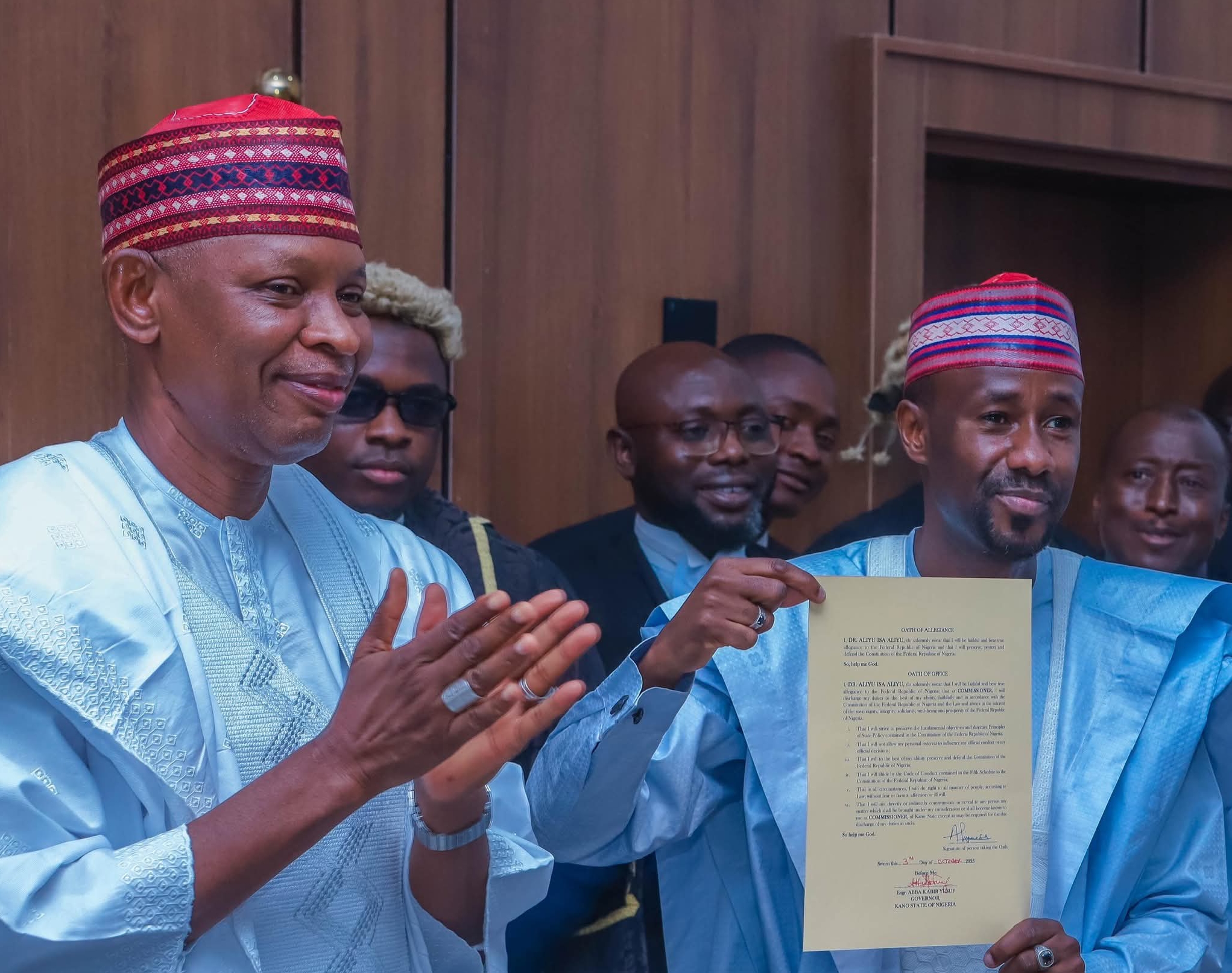
By Aliyu Isa Aliyu, Ph.D
As the 2027 general elections draw closer, political conversations in Kano are increasingly dominated by competing claims about which party has the stronger machinery and which political bloc is better positioned to win the state.
Much of the debate, however, is driven by sentiment, personality politics and social media narratives. A more useful approach would be to examine the numbers, electoral history, political structures and the movement of key actors across the political divide.
The Kano of 2019 was not the Kano of 2023. And the political configuration approaching 2027 is different from both.
Before making my argument, I believe it is important to put my political background on record—not as a credential, but to establish that my assessment is informed by some firsthand experience of the political structures under discussion.
My Kwankwasiyya journey did not begin in 2012 after I benefited from a foreign scholarship. It dates much further back.
My late father, Alhaji Isa Aliyu Danzabuwa, was a politician known to many in Kano’s political circles, particularly those associated with Senator Rabiu Musa Kwankwaso and Dr Abdullahi Umar Ganduje. From the early 1990s until his death in 2005, I grew up seeing politicians, especially from Bichi, regularly visit our home.
If political commitment could be inherited, I would say politics is in my blood.
My active participation in partisan politics began in 2007, when Hon. Ahmad Garba Bichi was the PDP governorship candidate. Ahead of the 2011 elections, I also worked actively for the victory of the PDP and Senator Rabiu Musa Kwankwaso, then the party’s governorship candidate.
As a young graduate, I served as a polling-unit agent at Shagari Quarters and participated in Kwankwasiyya’s “Dawo-Dawo” rallies across several local government areas under the coordination of the late Alhaji Balarabe Musa Kalla, the late Mustapha Sani Kabara and Hon. Mustapha Buhari Bakwana, alongside friends and colleagues including Akibu Isa Murtala, Bashir Ali Usman, Badaru Auwalu Yola and Abba Ben Umar, among others.
On election day, we spent the night at Guringawa Ward and later slept at the INEC office in Kumbotso Local Government Area before accompanying the ballot boxes to the state INEC office. I was also part of the celebration that followed the victory, beginning at Senator Kwankwaso’s Gandu residence.
We did these things without expecting appointments, contracts or personal benefits. We were motivated largely by the belief that the government we were helping to bring to power would provide better governance.
That experience gave me an opportunity to see, from the grassroots, how political mobilisation, organisation and electoral structures worked within the Kwankwasiyya movement.
It is from that perspective that I approach the 2027 question—not with hostility towards any political movement, but with an attempt to examine the available facts.
The Kano of 2019
The argument that APC has never had sufficient political strength in Kano does not stand up well against the electoral record.
In the 2019 presidential election, the APC candidate polled 1,464,768 votes in Kano State, compared with 391,593 votes for the PDP.
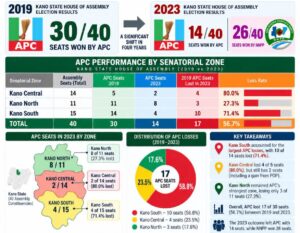
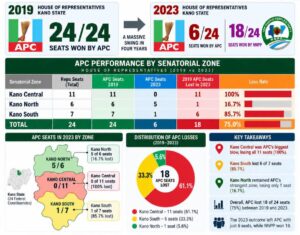
More significantly, the APC won all 24 National Assembly seats in the state.
At the state level, the APC won 30 of the 40 State House of Assembly seats and secured victory in 28 of the 44 local government areas in the initial governorship election.
Although the party trailed by 26,655 votes before the supplementary election, it eventually won the governorship by 8,982 votes.
These figures are important because they challenge the simplistic assumption that Kano elections are determined exclusively by the popularity of a single political personality.
If personality alone determined electoral outcomes, the PDP, led in Kano by Senator Rabiu Musa Kwankwaso at the time, would arguably not have suffered such a comprehensive defeat in 2019.
The lesson from that election is that political popularity matters, but so do party structures, organisation, alliances, resources and the ability to translate political support into votes.
What Changed in 2023?
The political landscape changed dramatically before the 2023 elections.
The APC presidential candidate received 517,341 votes in Kano State—a substantial decline from the party’s 2019 presidential tally.
The party also suffered major losses in the National and State Assembly elections.
In Kano Central, the APC lost all 11 House of Representatives seats to the NNPP. It also lost one seat in Kano North and five in Kano South. At the State Assembly level, the party lost 17 seats to the NNPP.
In the governorship election, the NNPP defeated the APC by 128,897 votes.
That was a significant margin, and the result should not be minimised. But it is equally important to understand the circumstances in which the election took place.
The APC entered the 2023 election deeply weakened by internal divisions and the departure of several influential politicians.
Among those who left the party, particularly in Kano South, were figures such as Hon. Kawu Sumaila, Hon. Kabiru Alhassan, Gwani Ali Bukar Makoda, Hon. Safiyanu Harbau and others.
Similar political losses occurred in Kano North and Kano Central, including the departure of former Governor Ibrahim Shekarau, who continued to command considerable political influence through the Shura movement.
These defections did more than change party membership. They transferred political experience, grassroots networks, mobilisers and organisational structures from one political camp to another.
In other words, the 2023 election was fought with an APC that had lost some of its most important political assets, while its principal opponent had gained many of them.
That distinction is crucial when comparing 2023 with 2027.
The Political Equation Heading Into 2027
The political equation has changed again.
The defection of the serving governor and a considerable number of his political associates has altered the balance of political structures across Kano’s 44 local government areas.
Several structures associated with the Kwankwasiyya political family—including CRC, Kano Proper, scholars, Lafiya Jari, Kwankwasiyya, NNPP and Option A structures, Jagorori, LGA caucuses, interstate teams and contact committees—have experienced significant defections.
Based on my knowledge of some of these structures, I estimate that a substantial proportion of their members have moved to the APC, with some structures losing as much as 70 per cent of their personnel.
That estimate can, of course, be debated and should ideally be tested against independently verifiable membership and electoral data. But the broader phenomenon is difficult to ignore: political actors and grassroots organisers who previously operated within one camp are now increasingly distributed across another.
These are not merely names on a list.
Political structures are valuable because they consist of people who know the wards, polling units and communities; people who understand voter mobilisation; people who can coordinate agents; and people who have established relationships with local political actors.
Such networks take years to build.
The movement of prominent political figures has also been substantial.
Among those who have moved away from the Kwankwasiyya camp are Ahmad Garba Bichi, Audu Kirare, Dayyabu Maiturare, Baffa Sani Gaya, Ali Bukar Makoda, Isiyaku Ali Danja, Dr Danyaro Yakasai, Surajo Harisu Danbatta, Umar Haruna Doguwa, Gambo Sallau, Garba Hungu, Yusuf Ogan Boye, Dr Baffa Bichi, Hamza Maifata, Muhammad Ahmad, Butu-Butu of Rimin Gado, Tijjani Abdulkadir Jobe, Ali Madaki and many others.
The significance of these movements should not be assessed merely by the number of political leaders involved. Their importance lies in the networks that accompany them.
A politician who changes parties may bring with him political organisers, ward leaders, supporters, campaign coordinators and longstanding relationships.
This was precisely what happened to the APC ahead of the 2023 election when several of its influential figures defected to the opposition.
The difference now is that the direction of movement appears to have changed.
Structures Matter
One of the mistakes political observers often make is to confuse social-media visibility with electoral strength.
A party can dominate online conversations and still struggle at the polling unit.
Conversely, a political organisation may generate relatively little noise online while maintaining an extensive grassroots network.
Elections are ultimately conducted at polling units.
Between the political speech and the final result lies an enormous organisational chain: voters must be identified and mobilised; campaign structures must function; polling agents must be recruited and trained; transportation and communication must be coordinated; results must be collated and monitored; and political alliances must remain intact until the final declaration.
This is why political structures matter.
The 2027 contest in Kano should therefore not be reduced to the question of which politician is more popular or which party has the louder supporters online.
The more important questions are: Who controls the grassroots structures? Who has functional ward and polling-unit networks? Who can mobilise voters? Who can maintain those structures throughout the campaign? Who can coordinate election-day operations? And, ultimately, who can convert political support into actual votes?
The Numbers Must Speak
None of this means that the APC has already won Kano.
Elections are not won by historical comparisons alone, and political structures can change rapidly.
The APC will still have to manage its own internal contradictions, accommodate its new entrants, maintain cohesion and convince voters that its platform deserves their support.
Likewise, the NNPP and Kwankwasiyya should not be written off. They retain significant political assets, loyal supporters and a political identity that has been built over many years.
But acknowledging those strengths should not prevent an honest assessment of the changes that have occurred.
The central point is simple: 2027 is not 2023.
The APC that contested Kano in 2023 is not necessarily the APC that will contest Kano in 2027. Similarly, the political structure that propelled the NNPP to victory in 2023 is not exactly the same structure approaching the next election.
The movement of political actors has altered the equation.
Therefore, anyone attempting to predict the outcome of the 2027 Kano election should look beyond political noise, emotional attachment and social-media trends.
History provides the context. Numbers provide evidence. Structures provide the machinery. Alliances provide additional strength. And voters ultimately provide the verdict.
The most responsible way to analyse Kano 2027 is therefore not to ask who is making the most noise, but who has the numbers, the structures, the organisation and the capacity to turn political support into votes.
When the votes are eventually cast and counted, it will not be social media that determines the winner.
The numbers will speak.
Aliyu Isa Aliyu, Ph.D, is a commissioner Ministry of Livestock Development, Kano State.
Aliyu Ismail Diso
It is with a heavy heart and a profound sense of sorrow that I pay this tribute to a true friend, a brother and a remarkable human being, Malam Bello Muhammad Sharada, whose life was cut short on August 31, 2026, at the age of 56.
My relationship with Bello did not begin yesterday. We knew each other from childhood, when he was only about 10 years old and I was three years his senior. Our families had a long-standing relationship strengthened by close friendship and intermarriage. My stepmother, Hajiya Amina Misau, popularly known as Hajia Ya, was the younger sister of his father, Alhaji Muhammadu. From those early years, a beautiful bond of friendship, affection and mutual respect developed between us.
As the years passed, that bond grew stronger. What began as childhood friendship eventually became something much deeper. Bello was no longer simply a friend; he became a brother to me.
He was a man of admirable character, kindness and compassion. He had a special way of relating with people and bringing warmth and happiness to those around him. His words of encouragement, his philosophical understanding of Islamic teachings on brotherhood, and his willingness to stand by his friends and family were among the qualities that made him exceptional.
For many years, we shared memories, experiences, challenges, laughter and countless moments that I will forever cherish. Our lives also took us through different stages of the journalism profession, a field to which he devoted much of his life.
Bello was deeply involved in print journalism. He served as an editor of Al-Tajdid Islamic Newspaper of Jama’atu Tajdidul Islam in 1996, under the Chief Editor, Malam Aminu Aliyu Gusau, Modibbo Gusau. While he devoted himself largely to print journalism, I pursued broadcasting. Our shared professional interests, however, continued to bring us together.
In 2007, we worked as research assistants to Malam Ibrahim Ado Kurawa, the former Director-General of the Research and Documentation Directorate at the Kano State Government House. Bello later served as editor of Demokuradiyya a Yau, a Hausa newspaper, while working as a desk officer responsible for newspaper production and management under the Research and Documentation Directorate.
Beyond his professional accomplishments, Bello will be remembered for the lives he touched through his words, wisdom and personal relationships. His pen was not merely a tool of journalism; it was an instrument through which he sought to influence behaviour, enlighten society and inspire the younger generation.
His writings, particularly those shared on social media, reflected his deep thoughts, wisdom and understanding of life. Even in his final days, his thoughtful reflections left messages that continue to resonate with those who followed his work.
His death has created a painful emptiness that words cannot adequately describe. Yet, in the midst of this grief, I find comfort in the beautiful memories he left behind.
The calibre and number of people who gathered at his funeral prayers testified to the impact he had on the lives of others. It was a powerful demonstration that Bello lived among people with kindness, friendship, simplicity, firmness and mutual respect.
My dear Bello, you may have left this world, but you will never leave our hearts. Your friendship, brotherhood, wisdom and memories will remain with us.
May Almighty Allah forgive your shortcomings, accept your good deeds, have mercy upon you, grant you eternal peace and admit you into Jannatul Firdaus.
To the family you left behind, especially Mubarak and his 11 siblings, I pray that Almighty Allah grants you strength, patience and courage to bear this immense loss. May He comfort the entire family and grant you the fortitude to carry on with the values and legacy he left behind.
Rest in peace, my dear friend and brother.
Aliyu Ismail Diso, is a veteran journalists in Kano.

Kano Police Arrest Eight in Drug, Thuggery Raids

Funeral Prayer Held for Late Shehu Kabir Bayero

Kano holds planning meeting on implementation of Nigeria learning passport

Kwankwaso, Gov Yusuf, Amnesty International Condemn Killing of Ibrahim Khalil Dan Shagamu

Kano Police arrest two suspects over death of Ibrahim Khalil Danshagamu

Kano State Out-of-School Children Survey Report 2026: From Evidence to Impact — A Roadmap For Educational Development

Kano schools to resume Sunday for 2026/2027 academic session

From Grade Level 03 to Director: A 35-Year Journey of Resilience and Service

Justice Abdullahi Mahmud Bayero of Court of Appeal Dies in Egypt

