
Headlines
Kidney patient fights for life, needs N15m for transplant


By Nazifi Dawud
Mahmud Aminu Daneji, a kidney disease patient, has been fighting for his life for the past 18 years.
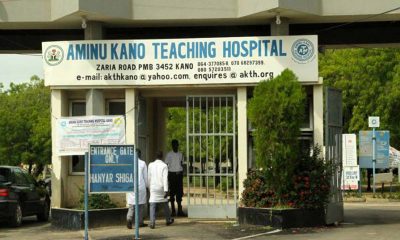
Mr Daneji, 46, who spoke to Kano Focus, while on a dialysis machine at Aminu Kano Teaching Hospital (AKTH), said his two kidneys failed simultaneously in 2001 after he was struck by severe hypertension.
“I used to be a very healthy and productive man before hypertension struck me down. I was living my life happily when suddenly my blood pressure shot to over 220 in March 2001,” he recalled.
He added that despite spending some time at the hospital receiving treatment, complications from the high blood pressure eventually damaged his kidneys.

Failed transplant
Mr Daneji, resident of Daneji quarters in Kano Municipal local government area of Kano state, narrated that from 2001 he had undergone a total of 476 dialysis sessions until October 2006 when he had a kidney transplant.
He said after the transplant, which was successful, he was able to regain good health that allowed him to continue with his life without pains.
“It felt as if I got a new life. My health problems seemed to have disappeared. In fact, I got married two years after the transplant and everything appeared to be Ok,” he said.
Alas, that respite gradually came to an end in October 2010, when the transplanted organ also failed. And like a horrible nightmare, Mr Daneji’s sorrow was renewed.
Since then, the father of one, said he has undergone 987 dialysis sessions–and still counting.
Each dialysis session, he said, used to cost him N17, 100 until AKTH considered his plight and gave him a 50 percent discount, meaning he now pays N8,550 twice a week.
Confined to a wheelchair, Mr Daneji said he has lost everything including his house.
“All I have are my lovely wife and 11-year-old boy,” he said, his voice cracking with emotions. “I am living for them”.
‘Why I need N15 million’
According to Mr Daneji, his first kidney transplant failed because, as doctors told him, he had a complicated genetic composition with a high possibility of rejecting foreign organs.
Mr Daneji’s case has proven complicated because apart from his aggressive genetic makeup, he had also received too many blood transfusions–which is also another challenge.
“When I did the HLA tissue typing tests, doctors advised that there is a 68 t0 70 percent that my body will reject a new kidney transplant due to my genetic makeup and too much blood transfusions,” he said.
Help in India
However, all hope is not lost for Mr Daneji as a hospital in India–Apollo International Kidney Centre, based in New Delhi has offered to help him at the cost of N15 million.
“I have been advised to seek treatment at the Indian hospital which has reputable kidney disease specialists that can solve my problem,” he said.
“This is why I am appealing for help from the government, well-meaning citizens, philanthropists and organizations to raise N15 million to seek treatment in India,” he added.
Hajiya Hauwa Abdullahi, a spokesperson for AKTH said anyone willing to help Mr Daneji can make donations through the hospital’s Social Welfare Office.
“Those willing to help Mahmud Daneji can call him on 08065514914 or contact me on 08065408993 or make donations through the Social Welfare Office at the AKTH,” she said.





Nasiru Yusuf Ibrahim
The management of Bayero University, Kano (BUK) has commenced a preliminary investigation into allegations linking a person reportedly identified as one of its students to acts of online impersonation and financial misconduct circulating on social media.
In a statement issued by the Director of Public Affairs, Lamara Garba, on behalf of the Registrar, the university said it had taken note of the claims being discussed in public commentary and across various online platforms.
The statement noted that BUK maintains strict standards of conduct, discipline, and character for all students throughout the duration of their studies, adding that any behaviour capable of bringing the name and reputation of the institution into disrepute is treated with the utmost seriousness.
According to the university, the alleged actions of an individual student should not be seen as a reflection of the values or character of Bayero University Kano as an institution.
“In view of the allegations, the University has commenced a preliminary inquiry to ascertain the facts surrounding the matter. The appropriate University authorities are reviewing the issue in line with the institution’s established rules and disciplinary procedures governing students’ conduct,” the statement said.
The management also commended the public-spirited efforts of Professor Farooq Kperogi and other individuals who provide financial assistance to students in need, particularly by supporting registration fees and other educational expenses.
The university noted that such acts of generosity continue to play an important role in expanding access to education and supporting deserving students.
BUK assured members of the public that if the allegations are substantiated, appropriate disciplinary measures will be taken in accordance with the university’s regulations and relevant laws.
The institution also urged the public to allow the investigative process to run its course and to refrain from speculation or the spread of unverified information.

Ibrahim Khalil
The Governor of Kano State, Abba Kabir Yusuf, has relieved the State Head of Service, Alhaji Abdullahi Musa, of his appointment with immediate effect.
KANO FOCUS reports that the development was disclosed in a statement issued on Tuesday evening by the Director-General, Media and Publicity, Government House Kano, Sunusi Bature Dawakin Tofa.
According to the statement, the decision forms part of the ongoing efforts of the current administration to reposition the state civil service for greater efficiency, discipline, and improved service delivery across government institutions.
Governor Yusuf expressed appreciation to the outgoing Head of Service for his contributions and dedication to the service of Kano State during his tenure.
“We wish him the best in his future endeavours and pray for his continued success in all aspects of life,” the governor said.
The governor also directed that Hajiya Bilkisu Shehu Maimota, Permanent Secretary, Administration and General Services at the Cabinet Office, should serve as Acting Head of Service pending the appointment of a substantive replacement.
The statement further directed the outgoing Head of Service to hand over the affairs of the office to the acting Head of Service no later than Wednesday, March 11, 2026.

Nasiru Yusuf Ibrahim
The Board Chairman of Belraados Limited and Kano State Chairman of the Arewa Consultative Forum (ACF), Dr. Goni Faruk Umar, on Saturday met with the former President of Brazil, Mr. Michel Temer, during the opening dinner of the 26th Expodireto Cotrijal in Brazil.
KANO FOCUS reports that Dr. Umar was seen exchanging a handshake with the former Brazilian leader at the event held in Não-Me-Toque, a city in the southern part of Brazil hosting the annual international agribusiness exhibition.
The Expodireto Cotrijal is one of the largest agricultural trade fairs in Latin America, attracting policymakers, agribusiness investors, researchers and stakeholders from across the globe to discuss innovations and opportunities in the agricultural sector.
Participants at the event are expected to explore partnerships and share ideas aimed at boosting agricultural productivity and strengthening international cooperation in agribusiness.

BUK probes student over alleged Facebook fraud

Gov. Yusuf relieves Kano Head of Service of appointment

Disabled student seeks urgent fix for faulty elevator at Northwest University Kano

Resident raises concern over rising lawlessness, poor urban planning in Kano

Kwaru Foundation Provides Free Eye Care to Over 1,100 Residents in Kano

Lami Maccido, first person to appear on screens of NTA Kano, CTV 67, dies at 72
Kwaru Foundation Provides Free Eye Care to Over 1,100 Residents in Kano

K-SAFE commends Kano for timely school census, inclusion of non-formal education data

Kano to distribute 16,906 desks to primary schools in 13 LGAs

