
Headlines
Court throws out Kano Emirate’s suit against additional emirates


Mukhtar Yahya Usman
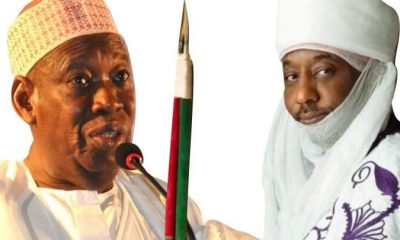
A Kano high court sitting at Audu Bako secretariat has dismissed the case filed by four Kano kingmakers challenging the creation of four first class emirs in the state.
KANO FOCUS reports that Justice Ahmad Badamasi held that the suit had already been overtaken by events given the fact that the law creating the new emirates in the state had been nullified by another high court in the state.
It could be recalled that the four kingmakers under the Emir of Kano, Malam Muhammad Sanusi II, had sued Governor Abdullah Umar Ganduje, Speaker, Kano State House of Assembly, Attorney-General and Commissioner for Justice and the new First Class emirs over the legitimacy of the new laws.
The kingmakers–Madakin Kano, District head of Dawakintofa, Yusuf Nabahani; Makaman Kano, District head of Wudil, Abdullahi Sarki-Ibrahim; Sarkin Dawaki Mai Tuta, District head of Gabasawa, Bello Abubakar and Sarkin Ban Kano, District head of Dambatta, Mukhtar Adnan–had approached the court asking it to declare the laws illegal, unconstitutional and, null and void.

Delivering his judgment, Justice Badamasi averred that the validity of the law was the whole issue for determination.
The judge, who cited the verdict of Justice Usman Na’Abba of similar jurisdiction of same subject matter, insisted that series of events had overshadowed the prayers of the plaintiffs.
He noted that the court had taken judicial notice of judgment delivered by Justice Na’Abba dated November 21, 2019, nullifying the law.
He, however, insisted that any action taken might amount to nullity, devoid of legal effect.
After the nullification of the emirate law, Kano State Executive Council had instituted fresh emirate bill to the state Assembly, which had since passed and signed into law.
The new Kano emirs’ appointment and deposition law 2019 was seen by many as affront to traditional heritage of Kano emirate and deliberate attempt to cripple the influence of Emir Sanusi.





Nasiru Yusuf Ibrahim
The management of Bayero University, Kano (BUK) has commenced a preliminary investigation into allegations linking a person reportedly identified as one of its students to acts of online impersonation and financial misconduct circulating on social media.
In a statement issued by the Director of Public Affairs, Lamara Garba, on behalf of the Registrar, the university said it had taken note of the claims being discussed in public commentary and across various online platforms.
The statement noted that BUK maintains strict standards of conduct, discipline, and character for all students throughout the duration of their studies, adding that any behaviour capable of bringing the name and reputation of the institution into disrepute is treated with the utmost seriousness.
According to the university, the alleged actions of an individual student should not be seen as a reflection of the values or character of Bayero University Kano as an institution.
“In view of the allegations, the University has commenced a preliminary inquiry to ascertain the facts surrounding the matter. The appropriate University authorities are reviewing the issue in line with the institution’s established rules and disciplinary procedures governing students’ conduct,” the statement said.
The management also commended the public-spirited efforts of Professor Farooq Kperogi and other individuals who provide financial assistance to students in need, particularly by supporting registration fees and other educational expenses.
The university noted that such acts of generosity continue to play an important role in expanding access to education and supporting deserving students.
BUK assured members of the public that if the allegations are substantiated, appropriate disciplinary measures will be taken in accordance with the university’s regulations and relevant laws.
The institution also urged the public to allow the investigative process to run its course and to refrain from speculation or the spread of unverified information.

Ibrahim Khalil
The Governor of Kano State, Abba Kabir Yusuf, has relieved the State Head of Service, Alhaji Abdullahi Musa, of his appointment with immediate effect.
KANO FOCUS reports that the development was disclosed in a statement issued on Tuesday evening by the Director-General, Media and Publicity, Government House Kano, Sunusi Bature Dawakin Tofa.
According to the statement, the decision forms part of the ongoing efforts of the current administration to reposition the state civil service for greater efficiency, discipline, and improved service delivery across government institutions.
Governor Yusuf expressed appreciation to the outgoing Head of Service for his contributions and dedication to the service of Kano State during his tenure.
“We wish him the best in his future endeavours and pray for his continued success in all aspects of life,” the governor said.
The governor also directed that Hajiya Bilkisu Shehu Maimota, Permanent Secretary, Administration and General Services at the Cabinet Office, should serve as Acting Head of Service pending the appointment of a substantive replacement.
The statement further directed the outgoing Head of Service to hand over the affairs of the office to the acting Head of Service no later than Wednesday, March 11, 2026.

Nasiru Yusuf Ibrahim
The Board Chairman of Belraados Limited and Kano State Chairman of the Arewa Consultative Forum (ACF), Dr. Goni Faruk Umar, on Saturday met with the former President of Brazil, Mr. Michel Temer, during the opening dinner of the 26th Expodireto Cotrijal in Brazil.
KANO FOCUS reports that Dr. Umar was seen exchanging a handshake with the former Brazilian leader at the event held in Não-Me-Toque, a city in the southern part of Brazil hosting the annual international agribusiness exhibition.
The Expodireto Cotrijal is one of the largest agricultural trade fairs in Latin America, attracting policymakers, agribusiness investors, researchers and stakeholders from across the globe to discuss innovations and opportunities in the agricultural sector.
Participants at the event are expected to explore partnerships and share ideas aimed at boosting agricultural productivity and strengthening international cooperation in agribusiness.

BUK probes student over alleged Facebook fraud

Gov. Yusuf relieves Kano Head of Service of appointment

Disabled student seeks urgent fix for faulty elevator at Northwest University Kano

Resident raises concern over rising lawlessness, poor urban planning in Kano

Kwaru Foundation Provides Free Eye Care to Over 1,100 Residents in Kano

Lami Maccido, first person to appear on screens of NTA Kano, CTV 67, dies at 72
Kwaru Foundation Provides Free Eye Care to Over 1,100 Residents in Kano

K-SAFE commends Kano for timely school census, inclusion of non-formal education data

Kano to distribute 16,906 desks to primary schools in 13 LGAs

