
Headlines
AKTH probes suspected Lassa fever cases, traces contacts of deceased doctors, patient

Nazifi Dawud
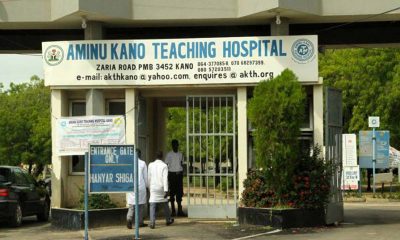
Aminu Kano Teaching Hospital (AKTH) has launched an investigation into possible cases of Lassa Fever after two of its medical personnel who had performed a Cesarean Section on a pregnant woman, died of a mysterious type of fever just days apart.
KANO FOCUS reports that the unnamed patient, who was said to have come from Bauchi state, had also died while a third doctor is currently fighting for his life at the Intensive Care Unit (ICU) of the hospital.
The two deceased doctors–Ummu Kulthum Abba, a house officer and Dr Habibu Musa, a consultant anesthetist–died on Friday and Monday respectively just 20 days after participating in the surgery on the pregnant woman.
In a statement, the Nigerian Medical Association (NMA), Kano chapter, had blamed the death of the medical personnel on “suspected cases of Lassa fever”, adding that “samples were taken to confirm diagnosis”.

The NMA said other suspected cases of the Lassa fever had received treatment with intravenous “Ribavrin” drug and were transferred out to Yar-gaya Isolation centre in Dawakin Kudu local government area of the state.
The AKTH management did not officially respond to a KANO FOCUS inquiry, but the hospital’s spokesperson Hauwa Abdullahi shared a WhatsApp message showing resolutions reached at the end of a stakeholders’ meeting held at the facility on the issue.
The first resolution on the message stated that “two cases of Pyrexia (fever) of Unknown Origin are being investigated in the hospital [as] samples were taken to the National Centre for Disease Control (NCDC) [while] contact tracing is presently being undertaken in conjunction with the state Ministry of Health.”
The second item on the message said “there will be a sensitization lecture tomorrow (Wednesday) to all hospital staff and thirdly staff “are advised to be calm and and observe safety precautions while providing services to all patients”.
The last item then warned staff to “be cautious of what they say in social media, to avoid unnecessary panic,”
The resolutions were signed by Dr Auwalu Umar Gajida, acting Chairman, Medical Advisory Committee of the AKTH.
Government keeps mum
However, both the Director, Public Health, Dr Imam Wada Bello and spokesperson of the Kano State Ministry of Health, Ismaila Gwammaja did not respond to calls and text messages by KANO FOCUS seeking comments on the suspected cases of Lassa fever in the state.
What is Lassa Fever?
According t0 the NCDC, Lassa fever is an acute viral haemorrhagic fever (VHF) caused by the Lassa virus. The natural reservoir for the virus is the Mastomys natalensis rodent (commonly known as the multimammate rat). Other rodents that carry the virus have also been identified.
Epidemiological data show that Lassa fever occurs throughout the year, but more cases are recorded during the dry season that November through May, the NCDC says in an advisory warning to health workers.
How is it spread?
Lassa fever, according to the NCDC, is spread through:
1. Direct contact with urine, faeces, saliva or blood of infected rodents.
2. Ingesting food and drinks contaminated with urine, faeces, saliva or blood of infected rats.
3. Contact with objects, household items or surfaces contaminated with urine, faeces, saliva or blood of infected rats.
4. Person-to-person transmission can also occur through contact with blood, urine, faeces, vomitus and other body fluids of an infected person, particularly in hospital environment where infection prevention and control practices are not optimal.
What are its symptoms?
The early stages of Lassa fever present initially like other febrile illness such as malaria, the NCDC says.
Symptoms of the disease generally include fever, headache, sore throat, general body weakness, cough, nausea, vomiting, diarrhoea, muscle pains, chest pain, and in severe cases; unexplainable bleeding from ears, eyes, nose, mouth, vagina, anus and other body orifices. It could also present as persistent bleeding from sites of intravenous cannulation.
The incubation period (time between an infection and appearance of symptoms of the disease) is 3 to 21 days. Early diagnosis and treatment increase the chances of survival.
Inappropriate use of personal protective equipment (PPE) such as gloves, masks and poor IPC practices, increase the risk of person to person transmission of Lassa fever.
What to do if you suspect any case of Lassa fever
According to NCDC, any febrile illness that has not responded to 48 hours use of anti-malaria or antibiotics should raise an index of suspicion for Lassa fever!
The national guidelines for Lassa fever case management and Infection prevention and control are available on the NCDC website for download (http://ncdc.gov.ng/diseases/guidelines).
Report all suspected cases of Lassa fever to your Local Government Area Disease Surveillance and Notification Officer (DSNO). They are the first link to response and care for Lassa fever cases in Nigeria.
Contact:
NCDC Toll-Free Number: 0800-970000-10
SMS: 08099555577
Whatsapp: 07087110839
Twitter/Facebook: @NCDCgov







Nasiru Yusuf Ibrahim
Governor Abba Kabir Yusuf of Kano State has approved the establishment of a Technical Committee to tackle the persistent issue of poor employment representation of Kano State indigenes in federal government agencies, as well as private and voluntary institutions operating within the state.
KANO FOCUS the committee was formally inaugurated by the Secretary to the State Government (SSG), Alhaji Umar Faruk Ibrahim, at his office in Kano. Speaking at the inauguration, the SSG expressed deep concern over what he described as the continued marginalisation of Kano indigenes in employment opportunities, despite Kano being the most populous state in the country.
He noted that Kano has not received its fair share of jobs, even in federal and private institutions located within the state, stressing that the high rate of unemployment among youths in Kano—believed to be higher than in any other state—demands urgent and decisive government intervention.
“This is the right time to reclaim what truly belongs to us,” Alhaji Umar Faruk Ibrahim declared, adding that the present moment offers an opportunity for meaningful and sustainable action.
A statement issued on Thursday by the Press Secretary in the Office of the SSG, Musa Tanko Muhammad, explained that the committee was carefully constituted with experienced individuals drawn from various sectors of public service.
He announced Dr. Danyaro Ali Yakasai, Special Adviser to the Governor on Policy and Social Development, as Chairman of the committee, with Dr. Ibrahim Garba Muhammad, Special Adviser on Human Resource, serving as Co-Chairman.
Other members of the committee include Salisu Mustapha, Permanent Secretary, Office of the Head of Civil Service; Ibrahim Muhammad Kabara, Permanent Secretary, Ministry of Special Duties; Hon. Ali Yahuza Gano, Special Adviser on Metropolitan Affairs; Alhaji Salisu A. Kabo, Director General, Youth Empowerment; and Hon. Ado Muhammad Wudil, Executive Secretary, Guidance and Counselling Board. The committee’s activities will be coordinated by Salisu Musa Aliyu, Principal Assistant Secretary in the REPA Directorate of the SSG’s Office.
The committee is mandated to review employment practices in federal, private, and voluntary institutions operating in Kano State, determine the level of employment of Kano indigenes, engage relevant organisations on recruitment guidelines, and collaborate with the Federal Character Commission to ensure fairness and compliance with existing regulations. Its ultimate objective is to develop practical and lasting solutions that will improve employment opportunities for Kano State indigenes.
Speaking on behalf of the committee, its Chairman, Dr. Danyaro Ali Yakasai, expressed gratitude to Governor Abba Kabir Yusuf for the confidence reposed in the team. He assured that members would work diligently to justify the trust and appealed to the people of Kano State for prayers and cooperation.
The committee is expected to submit its report within four weeks.

Nasiru Yusuf Ibrahim
President Bola Ahmed Tinubu has congratulated a former National Chairman of the All Progressives Congress (APC) and his long-time political ally, Dr. Abdullahi Umar Ganduje, on his 76th birthday, marked on December 25.
In a statement issued by his Special Adviser on Information and Strategy, Mr. Bayo Onanuga, President Tinubu described Dr. Ganduje as an astute politician and accomplished administrator who has devoted over five decades to public service in Nigeria.
The President recalled that Dr. Ganduje served the nation in several key capacities, including as a senior administrator in the Federal Capital Territory before returning to Kano State to serve as Commissioner for Works during the military era. He later became a two-term Deputy Governor of Kano State and subsequently served two consecutive terms as Governor of the state.
Dr. Ganduje, who also served as National Chairman of the APC, is currently the Chairman of the Federal Airports Authority of Nigeria (FAAN).
President Tinubu praised Ganduje’s enduring friendship and political collaboration, noting his significant contributions to the growth and stability of the ruling party.
“I will forever appreciate Ganduje’s friendship and close collaboration at different times, as well as his services to the APC,” the President said.
He prayed Almighty Allah to grant the former Kano State governor good health and long life to enable him to continue serving Nigeria and humanity.
Dr. Ganduje’s 76th birthday has drawn goodwill messages from political leaders and associates across the country, celebrating his long years of service and contributions to national development.
Headlines
NAHCON Secures ₦19 Billion Cost Reduction for 2026 Hajj, Pilgrims to Save Over ₦200,000 Each

Mukhtar Yahya Usman
The National Hajj Commission of Nigeria (NAHCON) has announced a ₦19 billion cost reduction for the 2026 Hajj, following a successful negotiation with Saudi service providers and Nigeria’s State Pilgrims’ Welfare Boards.
Chairman of the Commission, Professor Abdullahi Sale Usman, disclosed this while briefing journalists in Kano on the outcome of his recent official visit to Saudi Arabia. He explained that the deal translates to a direct saving of more than ₦200,000 per pilgrim. Nigeria has been allocated 66,910 Hajj slots for the 2026 pilgrimage.
During the visit, NAHCON signed key service contracts with Mashariq Dhahabiyya for Masha’ir operations and Daleel Al-Ma’aleem for transportation. It also secured better accommodation and feeding arrangements in the Markaziyya area of Madinah at competitive rates.
Professor Sale further announced the official fares for the 2026 Hajj as follows:
Maiduguri/Yola: ₦8.12 million
Other northern states: ₦8.24 million
Southern states: ₦8.56 million
He stressed that State Pilgrims’ Welfare Boards must remit 50 percent of the fares by October 8, 2025, while full payments from intending pilgrims are due by December 31, 2025.
“The deadlines are critical to enable early bookings and smooth operations,” he said, reaffirming NAHCON’s commitment to delivering a hitch-free Hajj exercise in 2026.
The NAHCON boss also appealed to the media for sustained support in sensitizing the public, noting that effective collaboration will ensure that the commission achieves its goals for Nigerians

Governor Yusuf sets up committee to address employment gaps against indigenes

Tinubu Congratulates Ex-APC Chairman Ganduje at 76

BPSR Ranks NCC among Top 3 MDAs in Best Website Performance in 2025

Quality of Service Challenges in Abuja

BEC Ranks NCC Among Top Five Best-Performing Government Agencies in 2025
BEC Ranks NCC Among Top Five Best-Performing Government Agencies in 2025
BPSR Ranks NCC among Top 3 MDAs in Best Website Performance in 2025
Quality of Service Challenges in Abuja
Governor Yusuf sets up committee to address employment gaps against indigenes
