
Opinion
2023: Why I Will Vote for Tinubu – Dr Tilde

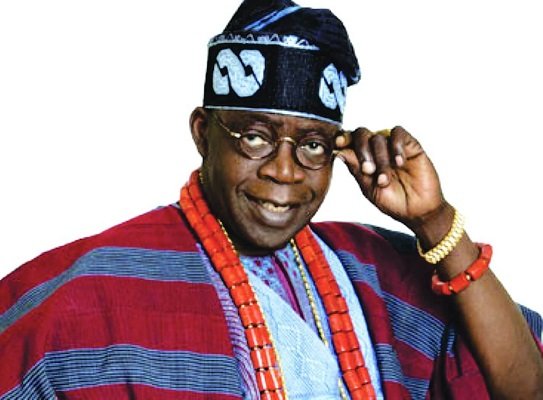
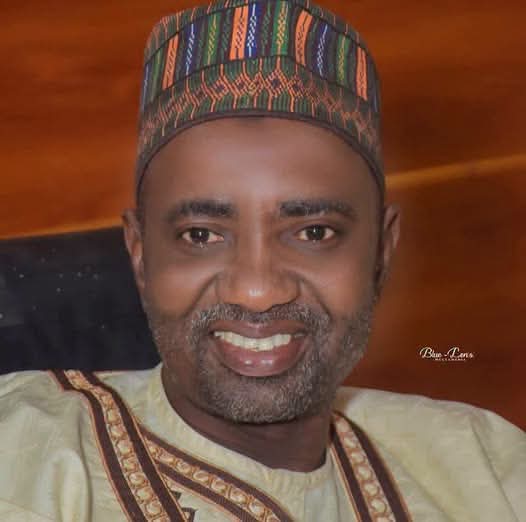
Dr. Aliyu U. Tilde
On 25 February 2023, I will pick this voter’s card, walk to the polling centre and cast my vote for His Excellency, Chief Ahmed Bola Tinubu, the Jagaban Borgu. This is a firm commitment given after a history of association, honour, demographic reality, constitutional requirement, weighing pros and cons as well as the personalities of the candidate and his running mate.
Association

In 2011, I supported the presidential candidature of Nuhu Ribadu. Together we travelled and met with the Jagaba many times in Lagos. Why I pitched my tent with Ribadu then, apart from sharing many things like age, world view, personality, background, geography, etc, was the firm belief that no matter how popular is a northern candidate, he needs to crossover to the South for additional votes and geographic spread that the constitution stipulates. For Buhari to run again that year, 2011, after two previous unsuccessful attempts, would be an exercise in futility as it indeed proved to be after failure of the last minute CPC/ACN merger attempt then. The results did not tie to warrant the second round as calculated in Buhari’s quarters. In 2015 the merger was done and victory was achieved. Elections are about law and numbers. No magic.
There will hardly be any southerner better fit for the position of a partner to the North than the Jagaba today. He is our Abiola, if not better. As some of my readers rightly said, he has patronized us many times: Atiku in 2007 under AC, Ribadu in ACN (2011) and Buhari in APC (2015). This is a consistent friend in need. Honour begets reciprocity.
Victimization
Furthermore, I am aware that the Muslim identity of the Jagaba has been used to disenfranchise him politically three times. In 2011, Buhari was not keen on the merger that required Pastor Bakare to withdraw for Tinubu because he Buhari was opposed to a Muslim-Muslim ticket after receiving over a decade of bashing from the southern press over shariah.
In 2015, Tinubu was bluntly and brutally told at a caucus meeting that he cannot deputize for Buhari because he was Muslim. He swallowed that and presented Osinbajo.
For the third time, for 2023, the some people want to crucify him for picking a Muslim as deputy against all odds. He believes that the Muslim identity of his running mate will earn him the winning vote and choosing a Northern Christian that will upset the Muslims will deny him our vote.
How honorable would I look if I would I turn my back against a friend in need who earlier provided platforms for my brothers and now believe in my capacity to rescue him? What if my son will contest the Presidency tomorrow and he goes to the Southwest to ask for support? And that day will come, when a northerner will again be in need of that alliance. Let us behave wisely. 2023 is not the end of Nigeria. We must guard the honour that we are known for.
Repeat Disaster
Southern partners of the north have been changing over the years but they remain constantly relevant. The North must not return to those days of serial losses by promoting a candidate acceptable only to it. This is the situation that the Atiku ticket presents today, regrettably.
Our brother, the Wazirin Adamawa, His Excellency, Alhaji Atiku Abubakar, has failed, against all advice, to patiently nurture the support of the South-south in 2011 after losing the ticket to the incumbent. Instead, he supported Buhari of the opposing CPC. Worse still, in 2015 he abandoned the the PDP, led 5 governors in rebellion against the southern President, claiming that it was the north’s turn, and decamped to APC to humiliate Jonathan out of power. Still after Bubari’s 8 years, in 2022, he blocked the emergence of Southeast and south-south candidates, claiming that rotation is a party matter.
Now he has gone to the south-south cup in hand and they paid him back in his own coins. This produced Peter Obi ticket and the G5; two blocks that will deny him the traditional PDP votes in the Southeast and South-south. Southwest is already effectively blocked against him by Tinubu.
The Waziri is effectively left with the North. Here, Benue, Plateau and Southern Kaduna are not likely to vote for “another Fulani”, as we heard them declare repeatedly. The votes of the Muslim North are themselves divided for and against him, not united as they were for Buhari. Borno and Yobe, will massively vote for APC. The ruling party even for kinship will also take Kwara and Kogi. Then incumbency will retain for APC the states of Kaduna, Niger, Zamfara, Gombe and possibly Katsina. Yes, Waziri will get Adamawa and Taraba and possibly Sokoto and Kebbi. Bauchi and Nasarawa are still uncertain for him. Kano belongs to Kwnkwaso, things being equal.
Then as Babachir and some anti-muslim irredentists are threatening northern Muslims of humiliation, a block vote, including Kano, in favour of the Muslim-Muslim ticket is possible. That will seal the fate of Atiku decisively.
Now, this calculus does not add up to an electoral win in any way. It is a recipe for the disasters of 2003, 2007 and 2011 to repeat themselves.
Existential Threat
Babachir’s insolence is an evil that must be disproved and defeated by both Muslims and Christians. Those who failed to earn the APC VP ticket should return and introspect on why they were not considered electorally viable enough to win it, not resort to blackmailing and threatening Muslims. That will only prove the evil that they are, which made it right for the Jagaba to reject them in the first place. Nobody can publicly say he will teach 120 million citizens a lesson and be allowed to succeed unless if those citizens are worse than donkeys. No lion can stand an army of 120 million donkeys. None.
Now Babachir’s insult has pushed even the reluctant Muslims to prove their electoral worth as they are increasingly rallying behind the Muslim-Muslim ticket. The majority well-meaning Christians should also do the same. Babachir is posing an existential threat to all northerners. If there is a Christian who will be fair to Muslims tomorrow, I and many Muslims will vote for him, as many of us did for Obasanjo and Jonathan between 1999 and 2011. But a genocidal psychopath of whatever religion does not deserve to be even a deputy local government chairman anywhere in this country. Let us leave him to grumble and crumble alone.
Same faith tickets are not new in Nigeria and they are presently practiced in all predominantly Christian States like Plateau, Benue, Edo and even in a number of Southwestern states where Muslims are predominant. Their Muslims have not threatened our national security for their selfish reasons as Babachir and his gang of rejects are doing up here. Tam.
Pros and Cons
Beyond the acquaintance, honour of reciprocity, averting past electoral disasters suffered by the North and the existential challenge of the Babachirs, the Tinubu/ Shettima ticket presents a lot of pros which my readers expressed when I asked their opinion on the my Facebook page last week. I share the views of those who are convinced of the Jagaba’s record performance in Lagos, arguably the best that the country has known of a governor since 1999, which, according to the readers, came from his courage, team work, modernity, foresight, talent hunting, etc.
For a person who also believes in efficiency, I cannot but be attracted to the Jagaba. Nigeria needs system upgrading and in some areas even disk reformatting. The Jagaba is the perfect person with the record to handle that squarely. No one better than him can pursue digital reform in commerce, taxation, education, governance, communications, etc. His pragmatism and penchant for modernity is needed to solve our security and other challenges. Who can project the success story of Lagos at the national level better than its original author—the Jagaba? None of my readers has denied him these qualities.
From among my readers who are opposed to the Tinubu Presidency are a number of cons which arise from five sources: the perceived limitations of age and the much touted fake stories of his sickness; the accusation of supporting OPC to kill Hausas in Lagos and their molestation while he was governor; the perception of tribalism, as the Igbo and Hausa too are accused of by others; his affiliation to APC and the President, seeing what the readers consider as the failure of the government in many areas in the past 8 years; and the predominantly Christian nature of his house.
Well on the first and last issues, the runner-up candidate, the Waziri, cannot completely acquit himself either. He too is old. Being over 70 he must have evidently slowed down and cannot disclaim having age associated illnesses. Above 60, one must have one or two. They both have slip tongues as President Buhari did in Germany and suffered issues of memory many times. Jos where both misnamed their parties—PDAPC and APDP—was no coincidence. Kwankwaso had it once in Kano too: NPCP. Mischief makers do not deserve our attention.
Even at 61, I have had many times that I could not recall names instantly. The brain just fails to retrieve the information from the disk as fast as when I was much younger. I had the privilege of meeting the Jagaba recently and was surprised that he negated those stories by holding me to a night conversation of one hour after a long day he had in Ebonyi. I watched him appear from his room, walked towards me straight, shook my hands and sat right beside me. There was no sign, then and not in his appearance at Chatham House and the BBC a week later, of a debilitating sickness as purported and he appears to get increasingly stronger. He is alert and he still argues his points as it better than the other candidates.
In any case, the strength of any leader is not in the class of his weight; otherwise, America would have made Tyson a President. It is in the people a leader rallies around him. To be fair to the Jagaba whose talent-hunting obsession is renowned, his Presidency as an institution will run be unhindered by his age. He cannot have our best, the Kashims, the Elrufai’s, the Ribadus, the Hadizas, the Modibbos, the Arabis, etc. and fail to perform. But if he will resort to family and friends instead of competence, then I concede that his age will become aggravating. He is not as old as Mahathir Mohammed or Joe Biden after all, not minding similar attacks from Trump during the 2020 campaigns which the latter has proven wrong.
All said about age, as Muslims, we must believe that “no soul shall die except by the will of God, a decree determined”, as He said in the Qur’an. Period. Furthermore, the constitution has foreseen that and made the necessary provisions, whether an elected President is living or dead.
The Christian component of the Waziri’s family cannot be denied and neither is he a better practicing Muslim than the Jagaba. None of them is a Sheikh or Imam, anyway. We are in the same boat.
The OPC related killings cannot be ascribed to the Jagaba just because he was the Governor of Lagos. We northerners in particular must understand that by now better than anyone. Unfortunately for the Jagaba, he was the Guinea Pig of insurrection in this dispensation. When the OPC came, we had no experience of Plateau, Boko Haram and Bandits. Is it justified for anyone now to equally accuse Governors Sheriff, Shettima, Zulum, Yari, Bello, El-rufa’i or even the President, who has all our war arsenal at his command, of being supporters or financiers or Boko Haram or Bandits? What will be our reaction—believe him or refute him? So if the late Sheikh Jafar were alive, he would have withdrawn his fatwa on the Jagaba for he would have known the hard way that Governors do not have the power of controlling high level violence. They can only cooperate with the Federal Government, which the Jagaba did and OPC was quelled though not before it left many innocents dead, as Boko Haram and bandits are doing for over a decade today.
All the major tribes accuse each other of tribalism. President Buhari is accused of preferring Hausa Muslims in appointments. The Hausa see the Yoruba as more tribal than them though. But the Jagaba has set a record to reckon here. More than any governor, he has elevated non-natives of Lagos including Hausas to levels of commissioners, helped many grow their businesses in Lagos including Dangote. Of course, as with Buhari in 1984 or Elrufai in FCT and now in Kaduna, anyone wanting to modernize cities has to encroach on the business spaces of the common man who is fond of erecting illegal structures. The Jagaba cannot modernize Lagos by magic. He has to touch such structures belonging to commoners too. But all said, I think his inclination for merit in administration will blunt his natural instinct of kinship, which we all share anyway. He may not give 3 ministries to a single Hausaman—as Buhari did to Fashola—but he will not suppress northern talent at all. His record denies that flatly.
Finally, there is nothing he can do regarding the failure of APC. He is undoubtedly its chieftain but not more. Do you want him to decamp to PDP on that count? The President and members of his cabinet should carry their cross—and so should governors, each in his own domain. The Jagaba has acknowledged the successes of the President and has promised to build on his good works. Where necessary, he will change course, surely. I am Bola Ahmed Tinubu, he told the BBC. Come again. Is the alternative—the PDP—in a better position than the APC when it comes to failure of administration?
So put generally, the pros of the Tinubu Presidency will by far outweigh its cons. Yet, there is another pillar of the ticket we must mention before we conclude this piece—the backup.
Kashim Shettima
In his choice of a running mate, the Jagaba has picked a very strategic one. Choosing Kashim earns him not only a reliable and loyal VP, but also a credible one. His Excellency, Alhaji Kashim Shettima, the former Governor of Borno State and a present senator, is not only highly competent but also carries a political aura that can shelter the entire North, coming from the prestigious Kanuri tribe and with the personal humility to listen, respect, engage and accommodate all. He is among our best. You can see him admirably reaching out to so many people and groups everyday, not taking anyone for granted. Yet, even as a future VP, former Governor and a Senator, he will go to the kettle and personally prepare coffea for his guest. That is humility personified.
The Jagaba did not look for a lackluster yes man of no firm roots. He went for a talent that is both loyal and strong enough to support the President, humble enough to follow him and honest enough to caution him. That is my friend and Kanuri master, Kashim. With the Jagaba as the President and him as the VP, I can find no safer shelter among the 2023 presidential camps.
Come with Me
These are my reasons for answering the call to support the Tinubu/Shettima ticket. And I call on every dispassionate mind to do so for the sake of unity and progress of our country. I am not only promising this cause my vote and that of my family, but I will also work hard to earn it many more, as much as my talent, body and resources can afford me in the next two months. Come with me.
May God be with us and guide us to what is best for our dear country as we vote for the next President on 25 February 2023.



Saleh Adamu Kwaru
The milestone of Nigeria’s foreign exchange reserves crossing $54.08 billion for the first time in nearly 18 years reads like a triumphant headline. On paper, it represents a towering financial fortress built by the Central Bank of Nigeria through steady oil revenues, aggressive monetary tightening, and unprecedented diaspora inflows. Yet, beneath these dazzling macroeconomic figures lies a deeply agonising paradox. For the average Nigerian, the euphoria of $54 billion in the vault feels less like a shared national victory and more like a cruel illusion—a distant celebration taking place in glass towers while the everyday citizen fights an exhausting daily battle for basic survival.
To understand the profound emotional disconnect felt on the streets today, one must travel back to December 22, 2008, the last time the reserves touched $54.21 billion. Eighteen years ago, that same numerical figure existed in a fundamentally different world. In 2008, a dollar exchanged for roughly ₦118 to ₦135. A worker earning a modest salary could walk into a market with dignity, buy family foodstuffs, pay rent comfortably, and still hold onto a sense of quiet hope for the future. Fuel was subsidised, school fees were manageable, and the middle class was a living, breathing reality rather than a fading memory. The reserve target then felt aligned with an atmosphere of tangible stability and shared prosperity.
Fast-forward to 2026, and the stark contrast breaks the heart. Today’s $54 billion reserve sits alongside a naira that trades around ₦1,315 to ₦1,390 per dollar—a staggering depreciation that has quietly eroded the life savings of millions. Where a bag of rice or a tank of petrol once took a minor fraction of a monthly wage, it now demands entire paycheques. The removal of energy subsidies, compounding transport costs, and an unyielding inflation rate have turned simple household decisions into nerve-wracking dilemmas. Parents stand in markets clutching cash that shrinks in real time, staring at prices that mock their hard work, forced to make heart-wrenching choices between feeding their children and paying for medical care.
The emotional plight of the ordinary Nigerian is defined by suffocating fatigue—the feeling of being trapped in an economic storm while reading news of a national windfall. There is a deep, unspoken grief over lost lifestyles, abandoned dreams, and the endless hustle that no longer yields a comfortable life. Every morning, millions wake up to navigate long commutes and skyrocketing living costs, carrying the emotional weight of a middle class that has been slowly wiped out. The daily narrative is no longer about building wealth or planning for retirement; it has been reduced to an urgent, high-stakes operational goal: surviving until tomorrow.
Ultimately, while $54 billion in foreign reserves provides necessary structural armour for sovereign credit ratings and currency stabilisation, a balance sheet cannot feed a hungry family or heal a weary spirit. Until the strength of those reserves filters down into stable food prices, affordable transportation, and genuine relief at the local market stall, the figure will remain an abstract triumph. The true measure of Nigeria’s wealth can never be captured solely in foreign exchange ledgers. It will only be realised when the ordinary citizen can finally breathe a sigh of economic relief and feel the dignity of their hard labour restored.
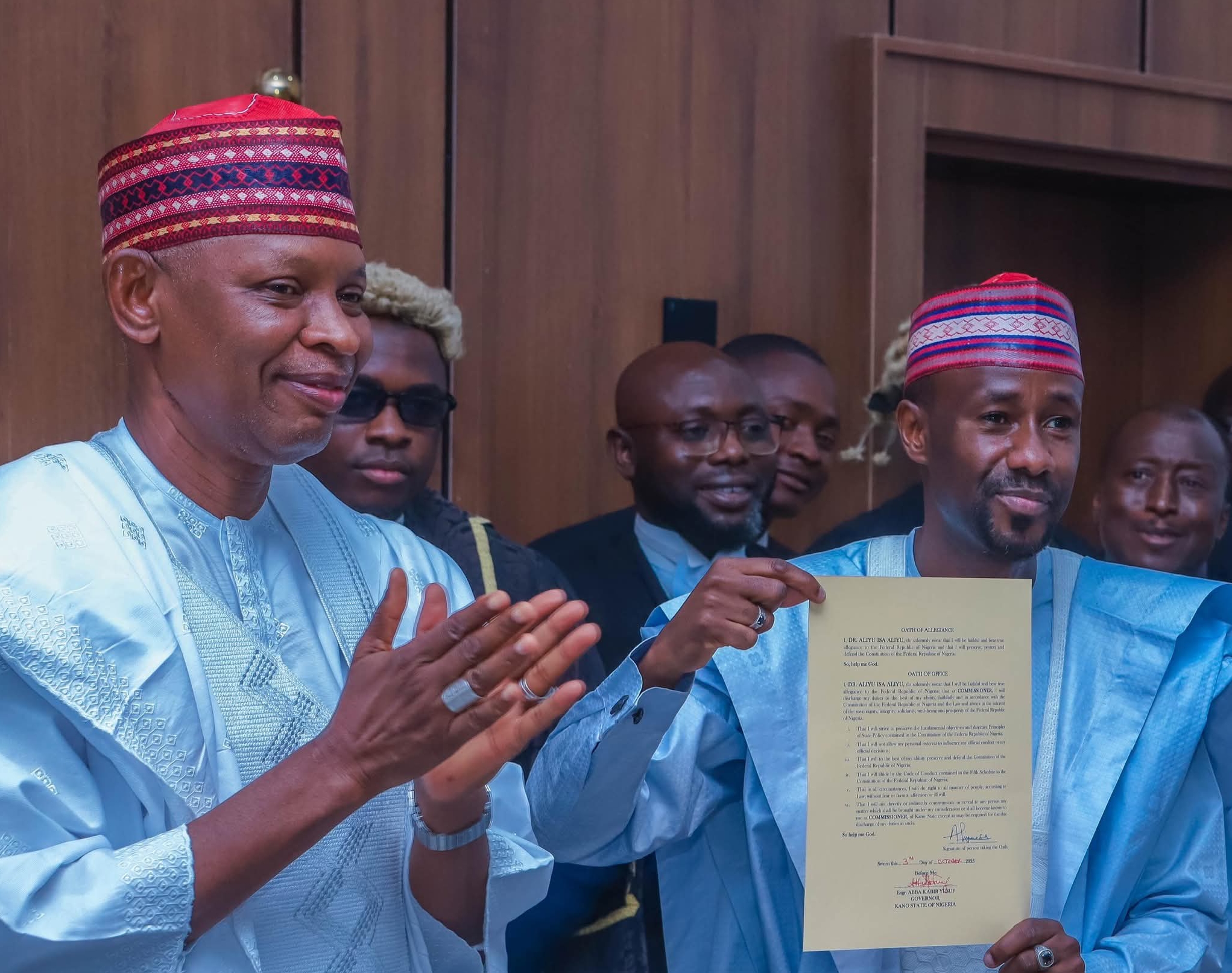
By Aliyu Isa Aliyu, Ph.D
As the 2027 general elections draw closer, political conversations in Kano are increasingly dominated by competing claims about which party has the stronger machinery and which political bloc is better positioned to win the state.
Much of the debate, however, is driven by sentiment, personality politics and social media narratives. A more useful approach would be to examine the numbers, electoral history, political structures and the movement of key actors across the political divide.
The Kano of 2019 was not the Kano of 2023. And the political configuration approaching 2027 is different from both.
Before making my argument, I believe it is important to put my political background on record—not as a credential, but to establish that my assessment is informed by some firsthand experience of the political structures under discussion.
My Kwankwasiyya journey did not begin in 2012 after I benefited from a foreign scholarship. It dates much further back.
My late father, Alhaji Isa Aliyu Danzabuwa, was a politician known to many in Kano’s political circles, particularly those associated with Senator Rabiu Musa Kwankwaso and Dr Abdullahi Umar Ganduje. From the early 1990s until his death in 2005, I grew up seeing politicians, especially from Bichi, regularly visit our home.
If political commitment could be inherited, I would say politics is in my blood.
My active participation in partisan politics began in 2007, when Hon. Ahmad Garba Bichi was the PDP governorship candidate. Ahead of the 2011 elections, I also worked actively for the victory of the PDP and Senator Rabiu Musa Kwankwaso, then the party’s governorship candidate.
As a young graduate, I served as a polling-unit agent at Shagari Quarters and participated in Kwankwasiyya’s “Dawo-Dawo” rallies across several local government areas under the coordination of the late Alhaji Balarabe Musa Kalla, the late Mustapha Sani Kabara and Hon. Mustapha Buhari Bakwana, alongside friends and colleagues including Akibu Isa Murtala, Bashir Ali Usman, Badaru Auwalu Yola and Abba Ben Umar, among others.
On election day, we spent the night at Guringawa Ward and later slept at the INEC office in Kumbotso Local Government Area before accompanying the ballot boxes to the state INEC office. I was also part of the celebration that followed the victory, beginning at Senator Kwankwaso’s Gandu residence.
We did these things without expecting appointments, contracts or personal benefits. We were motivated largely by the belief that the government we were helping to bring to power would provide better governance.
That experience gave me an opportunity to see, from the grassroots, how political mobilisation, organisation and electoral structures worked within the Kwankwasiyya movement.
It is from that perspective that I approach the 2027 question—not with hostility towards any political movement, but with an attempt to examine the available facts.
The Kano of 2019
The argument that APC has never had sufficient political strength in Kano does not stand up well against the electoral record.
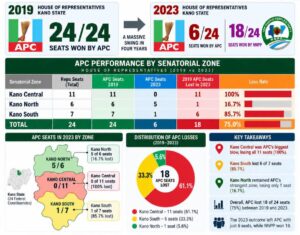
In the 2019 presidential election, the APC candidate polled 1,464,768 votes in Kano State, compared with 391,593 votes for the PDP.
More significantly, the APC won all 24 National Assembly seats in the state.
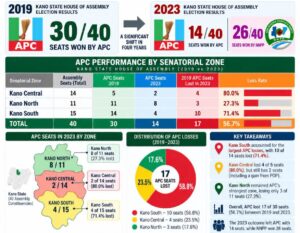
At the state level, the APC won 30 of the 40 State House of Assembly seats and secured victory in 28 of the 44 local government areas in the initial governorship election.
Although the party trailed by 26,655 votes before the supplementary election, it eventually won the governorship by 8,982 votes.
These figures are important because they challenge the simplistic assumption that Kano elections are determined exclusively by the popularity of a single political personality.
If personality alone determined electoral outcomes, the PDP, led in Kano by Senator Rabiu Musa Kwankwaso at the time, would arguably not have suffered such a comprehensive defeat in 2019.
The lesson from that election is that political popularity matters, but so do party structures, organisation, alliances, resources and the ability to translate political support into votes.
What Changed in 2023?
The political landscape changed dramatically before the 2023 elections.
The APC presidential candidate received 517,341 votes in Kano State—a substantial decline from the party’s 2019 presidential tally.
The party also suffered major losses in the National and State Assembly elections.
In Kano Central, the APC lost all 11 House of Representatives seats to the NNPP. It also lost one seat in Kano North and five in Kano South. At the State Assembly level, the party lost 17 seats to the NNPP.
In the governorship election, the NNPP defeated the APC by 128,897 votes.
That was a significant margin, and the result should not be minimised. But it is equally important to understand the circumstances in which the election took place.
The APC entered the 2023 election deeply weakened by internal divisions and the departure of several influential politicians.
Among those who left the party, particularly in Kano South, were figures such as Hon. Kawu Sumaila, Hon. Kabiru Alhassan, Gwani Ali Bukar Makoda, Hon. Safiyanu Harbau and others.
Similar political losses occurred in Kano North and Kano Central, including the departure of former Governor Ibrahim Shekarau, who continued to command considerable political influence through the Shura movement.
These defections did more than change party membership. They transferred political experience, grassroots networks, mobilisers and organisational structures from one political camp to another.
In other words, the 2023 election was fought with an APC that had lost some of its most important political assets, while its principal opponent had gained many of them.
That distinction is crucial when comparing 2023 with 2027.
The Political Equation Heading Into 2027
The political equation has changed again.
The defection of the serving governor and a considerable number of his political associates has altered the balance of political structures across Kano’s 44 local government areas.
Several structures associated with the Kwankwasiyya political family—including CRC, Kano Proper, scholars, Lafiya Jari, Kwankwasiyya, NNPP and Option A structures, Jagorori, LGA caucuses, interstate teams and contact committees—have experienced significant defections.
Based on my knowledge of some of these structures, I estimate that a substantial proportion of their members have moved to the APC, with some structures losing as much as 70 per cent of their personnel.
That estimate can, of course, be debated and should ideally be tested against independently verifiable membership and electoral data. But the broader phenomenon is difficult to ignore: political actors and grassroots organisers who previously operated within one camp are now increasingly distributed across another.
These are not merely names on a list.
Political structures are valuable because they consist of people who know the wards, polling units and communities; people who understand voter mobilisation; people who can coordinate agents; and people who have established relationships with local political actors.
Such networks take years to build.
The movement of prominent political figures has also been substantial.
Among those who have moved away from the Kwankwasiyya camp are Ahmad Garba Bichi, Audu Kirare, Dayyabu Maiturare, Baffa Sani Gaya, Ali Bukar Makoda, Isiyaku Ali Danja, Dr Danyaro Yakasai, Surajo Harisu Danbatta, Umar Haruna Doguwa, Gambo Sallau, Garba Hungu, Yusuf Ogan Boye, Dr Baffa Bichi, Hamza Maifata, Muhammad Ahmad, Butu-Butu of Rimin Gado, Tijjani Abdulkadir Jobe, Ali Madaki and many others.
The significance of these movements should not be assessed merely by the number of political leaders involved. Their importance lies in the networks that accompany them.
A politician who changes parties may bring with him political organisers, ward leaders, supporters, campaign coordinators and longstanding relationships.
This was precisely what happened to the APC ahead of the 2023 election when several of its influential figures defected to the opposition.
The difference now is that the direction of movement appears to have changed.
Structures Matter
One of the mistakes political observers often make is to confuse social-media visibility with electoral strength.
A party can dominate online conversations and still struggle at the polling unit.
Conversely, a political organisation may generate relatively little noise online while maintaining an extensive grassroots network.
Elections are ultimately conducted at polling units.
Between the political speech and the final result lies an enormous organisational chain: voters must be identified and mobilised; campaign structures must function; polling agents must be recruited and trained; transportation and communication must be coordinated; results must be collated and monitored; and political alliances must remain intact until the final declaration.
This is why political structures matter.
The 2027 contest in Kano should therefore not be reduced to the question of which politician is more popular or which party has the louder supporters online.
The more important questions are: Who controls the grassroots structures? Who has functional ward and polling-unit networks? Who can mobilise voters? Who can maintain those structures throughout the campaign? Who can coordinate election-day operations? And, ultimately, who can convert political support into actual votes?
The Numbers Must Speak
None of this means that the APC has already won Kano.
Elections are not won by historical comparisons alone, and political structures can change rapidly.
The APC will still have to manage its own internal contradictions, accommodate its new entrants, maintain cohesion and convince voters that its platform deserves their support.
Likewise, the NNPP and Kwankwasiyya should not be written off. They retain significant political assets, loyal supporters and a political identity that has been built over many years.
But acknowledging those strengths should not prevent an honest assessment of the changes that have occurred.
The central point is simple: 2027 is not 2023.
The APC that contested Kano in 2023 is not necessarily the APC that will contest Kano in 2027. Similarly, the political structure that propelled the NNPP to victory in 2023 is not exactly the same structure approaching the next election.
The movement of political actors has altered the equation.
Therefore, anyone attempting to predict the outcome of the 2027 Kano election should look beyond political noise, emotional attachment and social-media trends.
History provides the context. Numbers provide evidence. Structures provide the machinery. Alliances provide additional strength. And voters ultimately provide the verdict.
The most responsible way to analyse Kano 2027 is therefore not to ask who is making the most noise, but who has the numbers, the structures, the organisation and the capacity to turn political support into votes.
When the votes are eventually cast and counted, it will not be social media that determines the winner.
The numbers will speak.
Aliyu Isa Aliyu, Ph.D, is a commissioner Ministry of Livestock Development, Kano State.
Aliyu Ismail Diso
It is with a heavy heart and a profound sense of sorrow that I pay this tribute to a true friend, a brother and a remarkable human being, Malam Bello Muhammad Sharada, whose life was cut short on August 31, 2026, at the age of 56.
My relationship with Bello did not begin yesterday. We knew each other from childhood, when he was only about 10 years old and I was three years his senior. Our families had a long-standing relationship strengthened by close friendship and intermarriage. My stepmother, Hajiya Amina Misau, popularly known as Hajia Ya, was the younger sister of his father, Alhaji Muhammadu. From those early years, a beautiful bond of friendship, affection and mutual respect developed between us.
As the years passed, that bond grew stronger. What began as childhood friendship eventually became something much deeper. Bello was no longer simply a friend; he became a brother to me.
He was a man of admirable character, kindness and compassion. He had a special way of relating with people and bringing warmth and happiness to those around him. His words of encouragement, his philosophical understanding of Islamic teachings on brotherhood, and his willingness to stand by his friends and family were among the qualities that made him exceptional.
For many years, we shared memories, experiences, challenges, laughter and countless moments that I will forever cherish. Our lives also took us through different stages of the journalism profession, a field to which he devoted much of his life.
Bello was deeply involved in print journalism. He served as an editor of Al-Tajdid Islamic Newspaper of Jama’atu Tajdidul Islam in 1996, under the Chief Editor, Malam Aminu Aliyu Gusau, Modibbo Gusau. While he devoted himself largely to print journalism, I pursued broadcasting. Our shared professional interests, however, continued to bring us together.
In 2007, we worked as research assistants to Malam Ibrahim Ado Kurawa, the former Director-General of the Research and Documentation Directorate at the Kano State Government House. Bello later served as editor of Demokuradiyya a Yau, a Hausa newspaper, while working as a desk officer responsible for newspaper production and management under the Research and Documentation Directorate.
Beyond his professional accomplishments, Bello will be remembered for the lives he touched through his words, wisdom and personal relationships. His pen was not merely a tool of journalism; it was an instrument through which he sought to influence behaviour, enlighten society and inspire the younger generation.
His writings, particularly those shared on social media, reflected his deep thoughts, wisdom and understanding of life. Even in his final days, his thoughtful reflections left messages that continue to resonate with those who followed his work.
His death has created a painful emptiness that words cannot adequately describe. Yet, in the midst of this grief, I find comfort in the beautiful memories he left behind.
The calibre and number of people who gathered at his funeral prayers testified to the impact he had on the lives of others. It was a powerful demonstration that Bello lived among people with kindness, friendship, simplicity, firmness and mutual respect.
My dear Bello, you may have left this world, but you will never leave our hearts. Your friendship, brotherhood, wisdom and memories will remain with us.
May Almighty Allah forgive your shortcomings, accept your good deeds, have mercy upon you, grant you eternal peace and admit you into Jannatul Firdaus.
To the family you left behind, especially Mubarak and his 11 siblings, I pray that Almighty Allah grants you strength, patience and courage to bear this immense loss. May He comfort the entire family and grant you the fortitude to carry on with the values and legacy he left behind.
Rest in peace, my dear friend and brother.
Aliyu Ismail Diso, is a veteran journalists in Kano.

Kano Police Arrest Eight in Drug, Thuggery Raids

Funeral Prayer Held for Late Shehu Kabir Bayero

Kano holds planning meeting on implementation of Nigeria learning passport

Kwankwaso, Gov Yusuf, Amnesty International Condemn Killing of Ibrahim Khalil Dan Shagamu

Kano Police arrest two suspects over death of Ibrahim Khalil Danshagamu

Kano State Out-of-School Children Survey Report 2026: From Evidence to Impact — A Roadmap For Educational Development

Kano schools to resume Sunday for 2026/2027 academic session

From Grade Level 03 to Director: A 35-Year Journey of Resilience and Service

Justice Abdullahi Mahmud Bayero of Court of Appeal Dies in Egypt

